
- Agree on the name each spouse will use before updating any identity record or account.
- Use certified records and official instructions for government changes, and keep copies of every submission.
- Choose shared-money rules before moving balances, opening accounts, or changing recurring payments.
- Review benefits, beneficiaries, insurance, and emergency contacts as separate decisions rather than one combined form.
- Finish thank-you notes and create a simple anniversary plan while wedding details are still easy to recall.
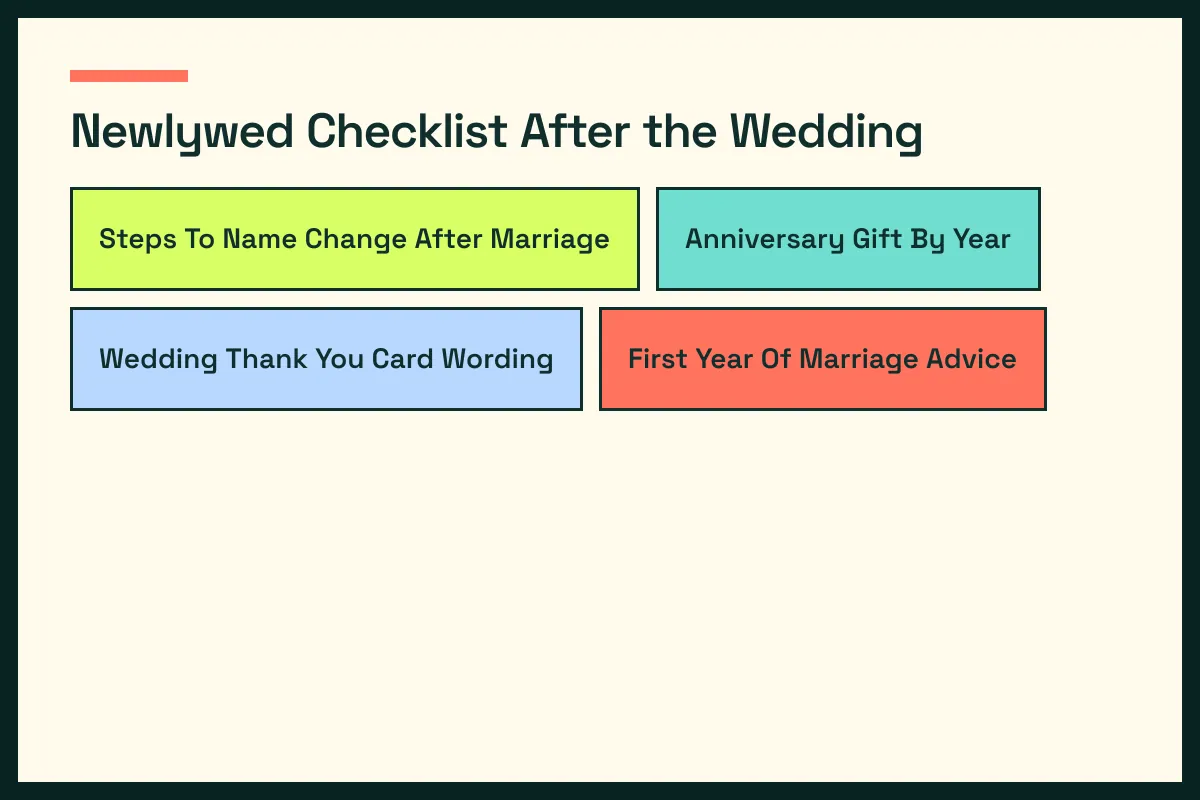
The wedding ended, but the decisions it started are now arriving in ordinary life. A newlywed checklist gives those decisions an order. It keeps an identity update from getting mixed into a bank conversation, and it keeps a small household task from hiding behind a larger legal one.
This is not a race to merge everything. Some couples combine accounts, some keep them separate, and many use both. Some spouses change a name, while others keep the names already on their records. The useful goal is simpler: every choice should be explicit, documented, and understood by both people.
What should go at the top of a newlywed checklist?
Put decisions with downstream effects first. A name choice affects identity records and account profiles. A move affects mailing addresses, insurance details, and recurring services. A benefits decision can affect beneficiary records and payroll information. If those choices are still open, write them as decisions rather than pretending they are routine errands.
Use one shared list with a clear owner beside each item. Ownership does not mean one spouse makes the decision alone. It means one person tracks the next action, keeps the confirmation, and tells the other when the item is finished. Shared responsibility works better when the next step belongs to someone.
Create a small record folder before submitting anything. Keep the source document, the instruction page you relied on, the date of submission, and any confirmation you receive. The folder may be digital or physical. Consistency matters more than the format.
Should either spouse change a name?
A married name is a personal choice. Decide what each spouse wants to use socially and what each will use on legal records. Those can be discussed together without assuming that one person must change.
If a spouse plans to update legal records, begin with the official name-change guides on this site. The state pages identify the saved vital-record and driver-license sources available for that state. The agency pages separate federal identity records from employer, bank, voter, and subscription updates. When a source does not prove a fee, deadline, form, or issuing office, the guide leaves that detail out and sends the reader back to the official source.
Do not update accounts randomly. A service may ask for an identity record that still shows the old name. Another may require the updated record. Follow the sequence published by the organization handling the change, and keep both names available when contacting an account provider during the transition.
How should newlyweds organize shared money?
Start with visibility. Each spouse should know which regular costs exist, which account pays them, and which person watches for changes. Visibility is useful whether money is combined or separate.
Then choose a structure. A fully shared system can make joint planning easy, but it may feel restrictive when personal spending preferences differ. Separate accounts preserve autonomy, but they require a reliable method for funding shared costs. A mixed structure can give the household a shared operating account while leaving each spouse personal spending space.
| Decision | Shared approach | Separate approach | Mixed approach |
|---|---|---|---|
| Household bills | Paid from one shared balance | Assigned between spouses | Funded through a joint bills account |
| Personal spending | Discussed inside one plan | Managed independently | Kept in personal accounts |
| Saving goals | Tracked together | Split by agreed responsibility | Joint goals plus personal goals |
| Record keeping | One shared view | Two views with regular review | Shared dashboard for common costs |
No structure fixes a missing conversation. Discuss what counts as a shared expense, how either spouse raises a concern, and what information both people can access. Avoid making one spouse the permanent translator of the household finances.
Which benefits and records deserve a fresh review?
Treat each benefit as its own choice. Health coverage, workplace benefits, retirement beneficiaries, life insurance, emergency contacts, tax withholding, and estate documents have different owners and different rules. Marriage may create an opportunity to review them, but it does not turn them into one universal update.
Use the official plan administrator or provider for the current instructions. Do not copy a form number from a general article. If an employer or provider asks for evidence, confirm what that specific organization accepts before sending personal records.
Beneficiary choices deserve direct attention. A contact entry is not automatically a beneficiary designation, and a beneficiary designation is not the same as a will. Review each record in its own system and note what remains undecided. The first-year guides explain the questions to ask without presenting personal financial or legal advice.
What household systems should a new couple set up?
Combine inventories before buying more things. List useful furniture, kitchen equipment, subscriptions, storage needs, and maintenance tools from both homes. Decide what stays, what moves, what is donated, and what genuinely needs replacing. A clear inventory prevents the new home from becoming a holding area for duplicate decisions.
Assign recurring work in plain language. “Handle the kitchen” is vague. “Plan groceries, check staples, and choose who cooks on work nights” is actionable. The same principle applies to cleaning, laundry, vehicle care, pet care, appointments, and family communication.
Keep access fair. Both spouses should know how to reach essential household information, even if one usually manages it. That includes lease or mortgage contacts, utility access, insurance contacts, repair information, and emergency details. Shared access reduces stress when the usual owner is unavailable.
How can newlyweds build routines without making marriage a project?
Use the checklist to remove background stress, then stop looking at it. A short recurring conversation can cover what changed, what needs a decision, and what can wait. The conversation should not become an inspection of the other spouse’s performance.
Discuss expectations that wedding planning may have hidden: quiet time, social plans, visits with relatives, holidays, work pressure, sleep, food, and the use of shared space. The purpose is not perfect agreement. It is to make assumptions visible before they harden into resentment.
Choose a repair habit for disagreements. One person may need time before talking, while the other prefers immediate resolution. Agree on how to pause, how to return to the subject, and what language feels respectful. A reliable return matters more than winning the first exchange.
What wedding tasks are still open?
Thank-you notes are easier when the gift list, guest list, and memories are still available. Match each gift or contribution to the people involved, add one specific detail, and write in the couple’s natural voice. Separate guides cover cash gifts, group gifts, gift cards, honeymoon funds, relatives, the wedding party, vendors, and delayed notes.
Close vendor and rental tasks as well. Return borrowed items, save final agreements and receipts, share any promised materials, and raise unresolved concerns directly with the relevant provider. Avoid turning a private service issue into a public review before giving the provider a fair description of the problem.
Preserve the memories you actually want. Back up photographs and video when they arrive, label the files so both spouses can find them, and record the names or stories that may be forgotten. A small amount of organization now makes future anniversary projects much easier.
How should a couple plan the first anniversary?
Start with meaning, not a shopping category. Decide whether the occasion should feel private, social, practical, playful, or reflective. The anniversary guides explain the traditional and modern themes recorded in the project’s editorial sources, then turn each theme into adaptable ideas.
A tradition is an invitation, not a requirement. A useful gift can follow the theme literally, refer to it through a material or activity, or ignore it in favor of something personal. Keep a note about why the idea fits your spouse. That note often carries more meaning than the category itself.
How do newlyweds turn this list into a workable plan?
Separate decisions, actions, and waiting. A decision needs a conversation. An action needs an owner. A waiting item needs a follow-up point. Mixing all three creates a list that looks busy but gives no clue what to do next.
Group related items by the record or provider involved. Keep identity tasks together, financial choices together, benefits together, household routines together, and wedding follow-up together. Work through one group at a time. If an official source is unclear, pause that item and ask the organization rather than filling the gap with a guess.
Mark completion with evidence. A remembered phone call is hard to verify later. A saved confirmation, updated record, or written note shows what changed and what did not. Keep sensitive material secure and remove copies you no longer need.
Questions newlyweds ask
What should newlyweds do?
Begin with decisions that affect other tasks: names, identity records, contact details, benefits, shared bills, and remaining wedding correspondence. Give every action a clear owner and keep evidence of completion.
What do newlyweds need?
They need access to important records, a shared view of household obligations, clear money rules, current emergency information, and permission to make different choices about names, accounts, and routines.
What do newlyweds do after wedding celebrations end?
They close unfinished wedding tasks, organize records, review benefits and finances, set up household routines, write thank-you notes, and begin planning the first year around their actual priorities.
What do newlyweds need for a house?
They need an inventory before a shopping list. Combine what both homes already contain, solve storage and maintenance gaps, assign recurring upkeep, and buy only what the household will use.
How do newlyweds handle finances?
They choose what is shared, what remains personal, how common costs are funded, and how both spouses can see the plan. The arrangement should be understandable, reviewable, and comfortable for both people.
A calmer way to begin married life
A good newlywed checklist does not prescribe one version of marriage. It makes choices visible. Decide first, use official instructions where a record is involved, document what changed, and leave room to revise household systems that do not work in practice.
The wedding was one coordinated event. Marriage is a series of ordinary agreements. A short, honest list can keep those agreements from being made by accident.