
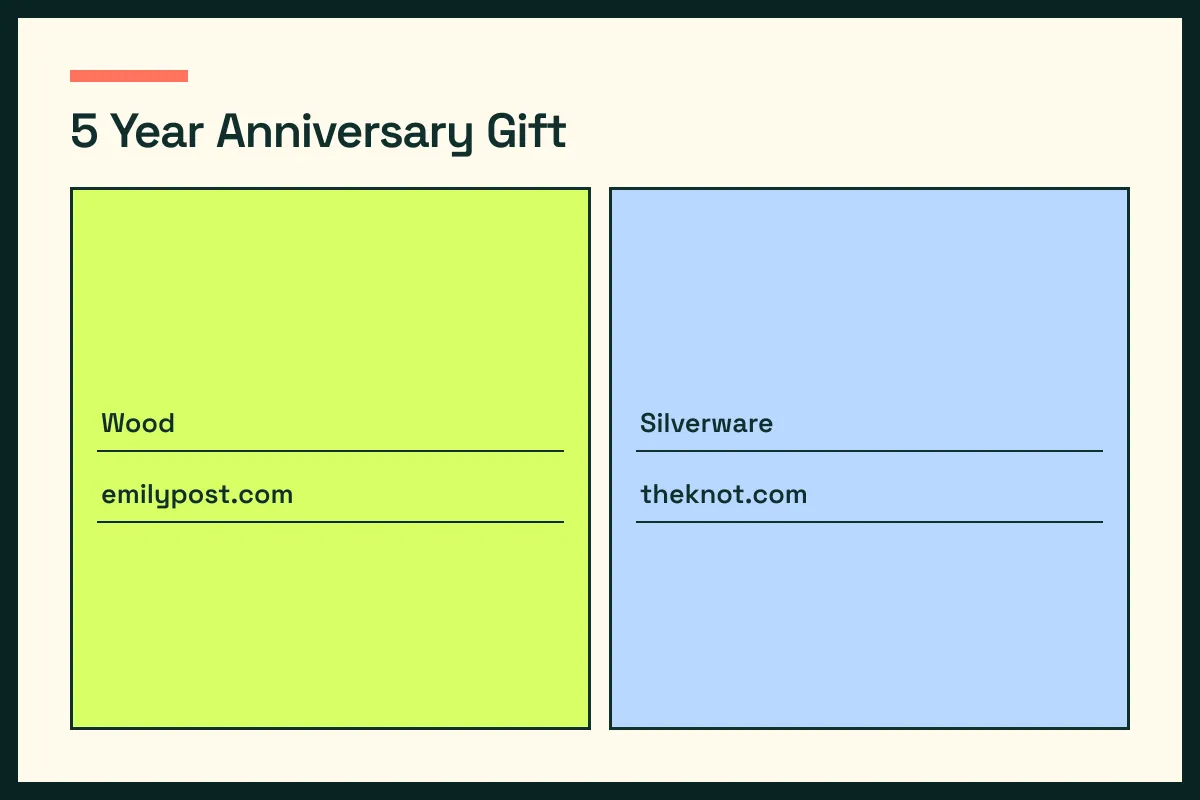
| Theme path | Documented theme | How to personalize it |
|---|---|---|
| Traditional | Wood | Connect the material to a shared memory or the recipient's habits |
| Modern | Silverware | Choose an object or experience that fits life now |
| Personal alternative | No theme required | Start with the recipient and explain the specific reason |
what is 5 year anniversary gift for him
what is 5 year anniversary gift traditional and modern
what is 5 year anniversary gift uk
what is 5 year anniversary gift theme
For anniversary year 5, the documented U.S. themes are Wood and Silverware. Treat them as creative boundaries, then choose an idea that fits the recipient’s taste and the couple’s story.
Wood can express something built and lived with; silverware can turn an ordinary shared meal into the center of the gift. The most useful choice carries a reason your spouse can recognize without reading an explanation of the anniversary list.
What are the traditional and modern themes?
Emily Post and The Knot both appear in the project data for the U.S. year 5 themes. They identify Wood as traditional and Silverware as modern. These are editorial theme labels, not rules for what a marriage should look like or how much a gift should cost.
Use the traditional and modern columns as parallel starting points. One may suit the recipient immediately. If neither does, borrow a quality from the material, such as recording, comfort, clarity, growth, strength, warmth, craft, or endurance, only where that interpretation fits the item and the couple.
Do not link the gift’s value to the anniversary number. The page data provides no budget, minimum, or expected scale.
How can the theme become a personal gift?
Start with an observed preference. Note what your spouse uses, repairs, collects, avoids, or talks about. Then test the theme against that evidence.
- A wooden keepsake made from a place or object with a shared story.
- A small piece of furniture chosen for a mutual routine.
- A carved box containing letters from the first five years.
- Silverware added to meals the couple already enjoys.
- A serving piece paired with a planned dinner at home.
These are directions, not product claims. Check size, material, comfort, care, and suitability with the recipient or maker when those details matter. A surprise should not require the recipient to maintain an object they did not want.
Should you choose the traditional or modern option?
Choose the route that produces the clearest connection. Wood works when it supports a real memory, activity, or object. Silverware works when it better matches how your spouse lives now.
A combined gift can work if each part has a purpose. Avoid joining themes merely to prove that both boxes were checked. One strong idea with a precise note usually feels more deliberate than a collection of unrelated references.
You may also ignore both themes. The anniversary list is an editorial tradition, not an obligation.
What can you write in the anniversary card?
Begin with a scene or behavior rather than a broad compliment. Tell your spouse what you noticed, why it mattered, and what you want to continue.
- Name the part of the relationship that feels firmly built.
- Name a mark or imperfection that became part of your story.
- Name a table memory you want to recreate.
- Name what you hope to keep making together.
A short message becomes personal through detail. Replace “you are always there” with the moment that proved it. Avoid a performance review of the marriage or a joke that depends on embarrassment.
How can you plan the moment around the gift?
Match the setting to the recipient. A private letter may need quiet time. An object for the home may feel better when used during a meal or routine. A planned activity needs agreement when it affects schedules, travel, comfort, or shared money.
Think about delivery as part of the meaning. Explain the connection in one or two natural sentences, then let the gift stand on its own. Do not give a lecture about symbolism.
Keep expectations visible. If one spouse wants a low-key evening and the other imagines a major event, discuss the shape of the celebration before the date carries the whole disagreement.
What should you avoid when using an anniversary theme?
Do not buy an item only because its material matches the list. Avoid household tools that create work for the recipient, clothing chosen without attention to comfort, decorative objects with no place, or expensive commitments made without agreement.
Do not treat a gendered search phrase as a complete preference profile. “For him,” “for her,” and “for wife” can describe the recipient, but they do not identify taste. Use what you know about the person.
Do not present the Emily Post or The Knot theme as law. Name the source tradition and keep the gift flexible.
How do you make the idea feel unique to year 5?
Connect it to one change, routine, or memory from this specific year of marriage. The material gives the idea a frame; the shared detail gives it ownership.
Write the reason before buying. If the reason could apply to any spouse and any year, the idea needs more detail. If it points to a moment only the two of you recognize, the theme has done its job.
The final test is simple: your spouse should feel seen first and themed second.