
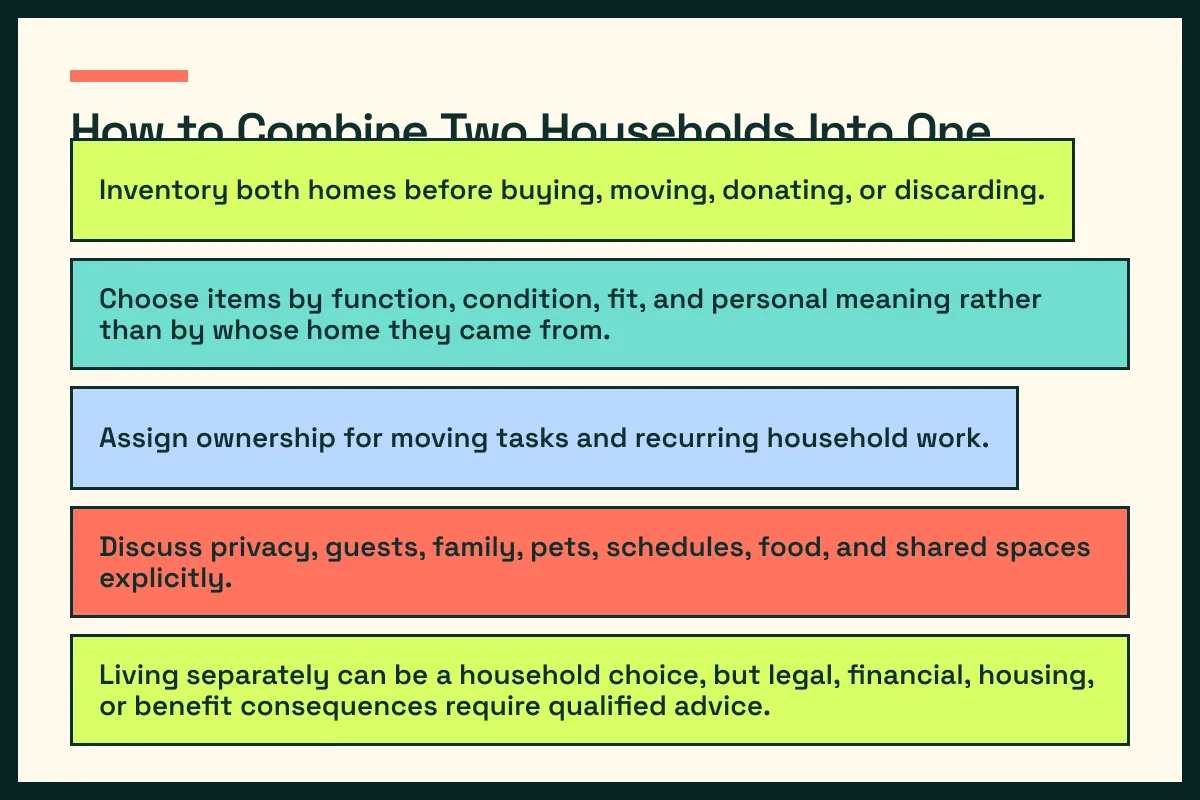
- Inventory both homes before buying, moving, donating, or discarding.
- Choose items by function, condition, fit, and personal meaning rather than by whose home they came from.
- Assign ownership for moving tasks and recurring household work.
- Discuss privacy, guests, family, pets, schedules, food, and shared spaces explicitly.
- Living separately can be a household choice, but legal, financial, housing, or benefit consequences require qualified advice.
- 1Inventory furniture, equipment, records, subscriptions, and sentimental items.
- 2Measure the shared space and assign a destination to each large item.
- 3Choose what moves, stays, is donated, is sold, or needs later review.
- 4Plan packing, transport, utilities, addresses, and access as separate tasks.
- 5Agree on storage, privacy, guests, routines, pets, and household work.
- 6Set money rules for shared costs and personal property.
- 7Review unresolved items after the household has operated in practice.
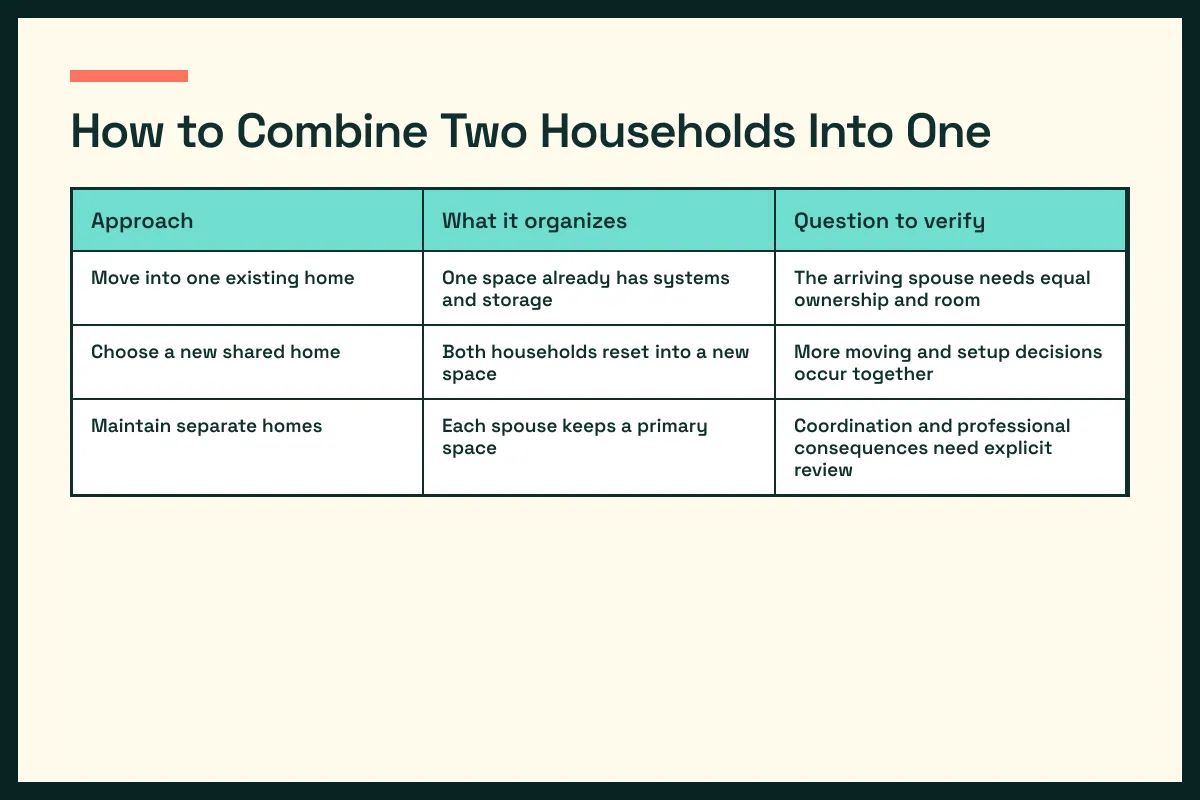
| Approach | What it organizes | Question to verify |
|---|---|---|
| Move into one existing home | One space already has systems and storage | The arriving spouse needs equal ownership and room |
| Choose a new shared home | Both households reset into a new space | More moving and setup decisions occur together |
| Maintain separate homes | Each spouse keeps a primary space | Coordination and professional consequences need explicit review |
how to combine two households into one
how to combine two families into one
merging two households into one
what couples should know before moving in together
what should couples do before moving in together
How to combine two households into one is partly a space problem and partly an ownership problem. A couple can fit every chair into a room and still leave one spouse feeling like a guest. A good merge decides where objects go, who runs household systems, and how both people shape the home.
Inventory first. Then choose, move, and review. That order prevents urgent logistics from deciding every permanent household rule.
What should you inventory before moving anything?
List furniture, kitchen equipment, electronics, linens, tools, records, subscriptions, sentimental items, pet supplies, and storage needs from both homes. Use broad categories first, then add detail only where a decision is required.
Mark each item’s function, condition, approximate size, owner, personal meaning, and possible destination. Do not decide its fate during the initial inventory.
Photograph or measure large items if that helps the space plan, but keep sensitive documents and access information out of a shared visual board.
How do you decide what fits the shared space?
Measure the destination and assign real zones for sleeping, cooking, work, storage, rest, and hobbies. Place essential functions before decorative items.
Compare duplicates by condition, fit, use, and meaning. Avoid a default rule that everything from the larger, newer, or destination home wins.
When two items both matter, consider rotation, storage, another room, or a later decision. Not every choice must be forced before the household has operated.
How can you avoid making one spouse feel like a guest?
Give both spouses visible decision rights. The person moving into an existing home should have space for belongings, routines, and preferences rather than being asked to fit into a finished system.
Review storage and display areas together. A single drawer or shelf is not equal household ownership.
Change some routines and spaces deliberately, even when the existing setup functions. The shared home should show that a new household was formed.
What should happen to duplicates?
Use a status list: keep, move, donate, sell, store, return, or review later. Assign an owner and next action to every item leaving a home.
Do not discard a spouse’s property without explicit agreement. Sentimental value may not be visible from function or condition.
Delay decisions that become emotional or rushed. Set a later review point and keep the item safe in the meantime.
How should couples plan the move itself?
Separate packing, transport, utilities, addresses, access, cleaning, returns, and setup into distinct tasks. Give each task an owner and a real completion signal.
Pack by destination zone, not only by the room an item leaves. Label essential first-use items so the household can function before every box is resolved.
Keep identity records, medications, financial files, keys, and irreplaceable items under secure personal control. Do not place them in an ordinary moving pile.
Which household rules deserve a direct conversation?
Discuss guests, family visits, quiet time, work schedules, sleep, food, cleaning, laundry, pets, shared-space use, privacy, and conflict repair. Use specific situations rather than abstract promises.
Ask what each spouse considered normal in the prior home. Hidden assumptions often appear only when someone violates a rule they never knew existed.
Write the decisions that affect recurring life. Leave room to revise them after practical experience.
How should household work be assigned?
Break chores into complete responsibilities. “Kitchen” may include planning food, shopping, cooking, cleaning, and monitoring supplies. Name the actual work.
Assign ownership fairly and create a backup for essential tasks. Fairness can consider time, ability, preference, and mental load without requiring identical lists.
Review the assignment when work or health changes. A task division is an operating agreement, not a permanent identity.
What money questions belong in the merge?
List shared housing costs, utilities, household purchases, moving costs, maintenance, and personal property questions. Decide what is shared and how it will be funded.
Keep account ownership separate from household responsibility. A spouse can contribute to a shared cost without automatically changing legal ownership of a lease, property, debt, or account.
Seek qualified advice where housing, tax, insurance, property, or legal consequences are unclear. This checklist cannot decide them.
Can married couples maintain separate homes?
The protected FAQ evidence asks the broader question, but the page data contains no legal or financial rule about separate homes. A couple may treat it as a relationship and logistics decision while seeking qualified advice about consequences.
Discuss cost, time, travel, care responsibilities, privacy, communication, and the definition of shared household work. Identify which systems remain joint and which stay local to each home.
Do not use a general article to decide residency, benefit, tax, lease, or insurance questions. Take those to the responsible source.
What should you review after the move?
Walk through unresolved boxes, storage pressure, duplicated services, missed chores, access problems, and spaces that still feel owned by one person. Ask what is working before focusing on complaints.
Correct the system. Move an item, redistribute a task, create a personal zone, cancel a duplicate service through its provider, or schedule a professional question.
Keep a short later list rather than trying to perfect the household immediately.
What makes the combined home durable?
Create a shared-home manual with only practical access information: service owners, maintenance contacts, storage locations, pet routines, emergency steps, and the place where secure records can be found. Do not copy passwords or identity documents into it.
Each spouse should be able to use the home when the usual organizer is away. Test that by asking where a repair contact, utility task, household supply, or essential instruction lives. Fix gaps without assigning blame.
Keep personal zones outside the manual unless their owner wants shared access. A combined household needs common continuity, not the removal of every private boundary.
Review the manual after an actual maintenance problem or schedule disruption. Replace vague entries with the contact, location, or owner that would have made the problem easier. Remove obsolete services only after the responsible provider confirms their status.
Let practical experience revise the original plan.
Both spouses can locate essential information, use the space, invite agreed guests, rest, work, and raise a concern. Objects have homes, recurring work has owners, and personal belongings retain respect.
The household should be revisable. New routines will reveal facts the moving plan could not predict.
Combining homes succeeds when neither person’s prior system silently becomes the law of the new one.