
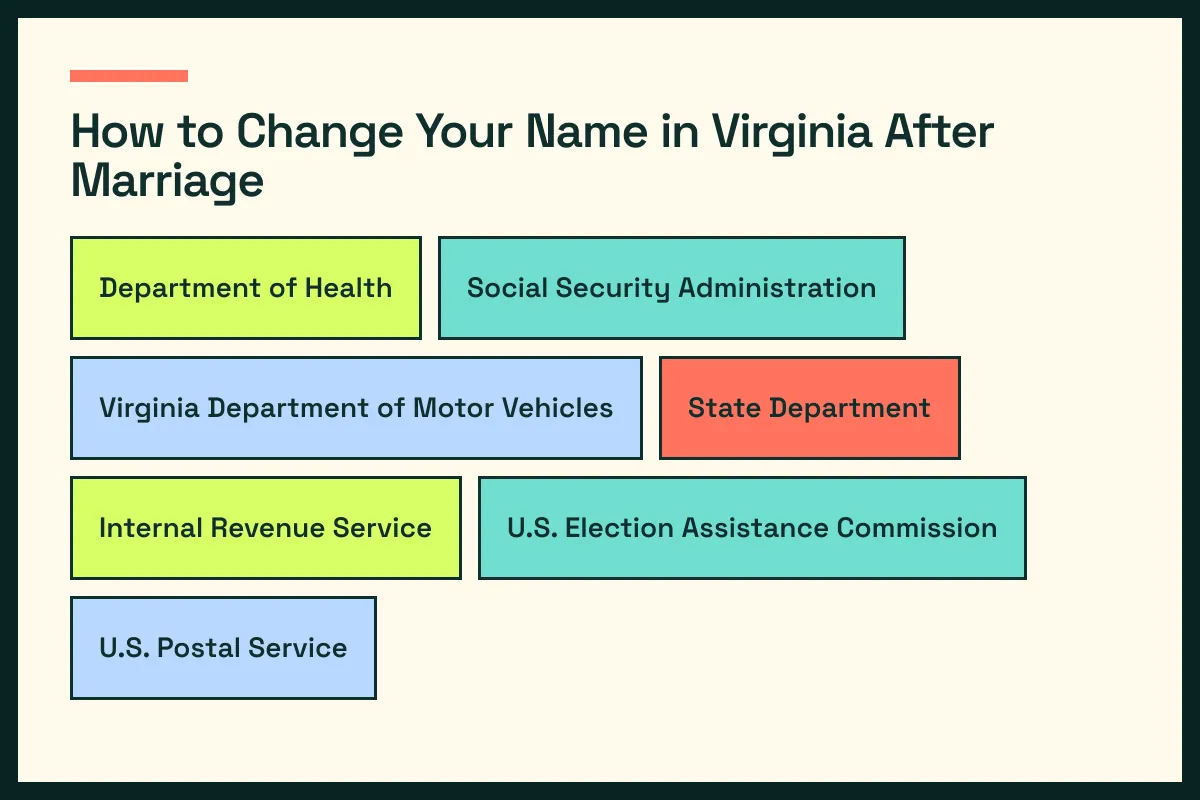
- Marriage-record source: Department of Health.
- Driver-record source: Virginia Department of Motor Vehicles.
- Voter source: Department of Elections.
- No certified-copy issuer is supported; saved source methods: online, mail, in-person, phone.
- 1Confirm the legal name you intend to use.
- 2Open the saved vital-record source and identify the evidence task.
- 3Verify the certified-copy route only where the state data supports it.
- 4Open the named driver source and follow its current instruction.
- 5Submit only through a channel the responsible source identifies.
- 6Check voter registration through its separate official source.
- 7Save each outcome and leave unresolved records open.
| Record owner | Task | Saved page type |
|---|---|---|
| Department of Health | Marriage-record evidence | procedure |
| Virginia Department of Motor Vehicles | Driver-license record | procedure |
| Department of Elections | Voter registration | procedure |
how to change your name in virginia after marriage
how to change your name in va after marriage
how to change last name in virginia after marriage
how to legally change your name in virginia after marriage
Changing a name in Virginia means changing specific records, not announcing one universal change. Work from the source that owns each record and preserve what that source confirms.
The Virginia data proves where each question begins, not every condition of the procedure. Missing facts stay missing until the responsible source provides them.
Where should a Virginia name change begin?
The saved vital-record source names Department of Health. Its URL is classified as a procedure page in the project data. Use that page to understand the marriage-record task and keep the page address with your checklist.
Keep one marriage-record question, one Department of Health source, and one next action. Federal and account changes receive different evidence later.
What does the data say about certified copies?
No certified-copy issuer is supported in the Virginia dataset, so none is named here. The captured method field contains online, mail, in-person, phone; use the official vital-record source to learn what each available route actually handles.
Do not use a department label to fill an empty copy field or carry another state’s route into Virginia. Only a traceable issuer value supports an issuer sentence.
How do you handle the driver-license record?
For the license record, the saved owner is Virginia Department of Motor Vehicles. The procedure link may be the specific procedure or a department landing page, so verify the exact route before preparing documents.
The driver dataset leaves timing blank. Ask Virginia Department of Motor Vehicles about the live sequence and keep the answer attached to the license task.
Where do you verify voter registration?
Finish the state review with Department of Elections, the stored procedure source. A confirmed driver record is not project evidence of a confirmed voter record.
Mark registration as preparing, submitted, needs clarification, or confirmed from its evidence. Other record outcomes do not choose that status.
What is the seven-step workflow?
Separate decisions from actions. A name choice belongs in the decision column; opening an official page and submitting a request are actions; waiting for a response remains open work.
Use the seven rows to distinguish thought, preparation, submission, and result. Only the owner can move a row from submitted to confirmed.
What can you do if a request is rejected?
When the live instruction and the response appear inconsistent, preserve both. Ask the responsible source to explain the difference and leave the checklist item open.
Treat ambiguity as unresolved. Ask the state owner for wording you can act on and retain the answer as evidence.
Why are neighboring state pages not interchangeable?
The related state guides are District of Columbia, Kentucky, Maryland, North Carolina, West Virginia. They are useful for orientation and site browsing, not as evidence for a Virginia requirement. Office names, URL types, copy routes, and stored methods can differ.
Use neighboring pages for related reading, then return to Virginia. A different office or link type proves difference, not a shared procedure.
How should you use the source table?
Treat the source table as an audit trail. It shows which Virginia owner answers each state question and whether the saved destination is a procedure or department page. Use Department of Health only for the vital task and Virginia Department of Motor Vehicles only for the driver task. The separate voter link completes the routing map.
How do you close the Virginia checklist?
Review the tracker by owner. Any Virginia record without a saved response or result remains open even if other work moved forward.
A durable plan can be audited without opening personal documents. Source, status, owner, and next action are enough for household coordination.