
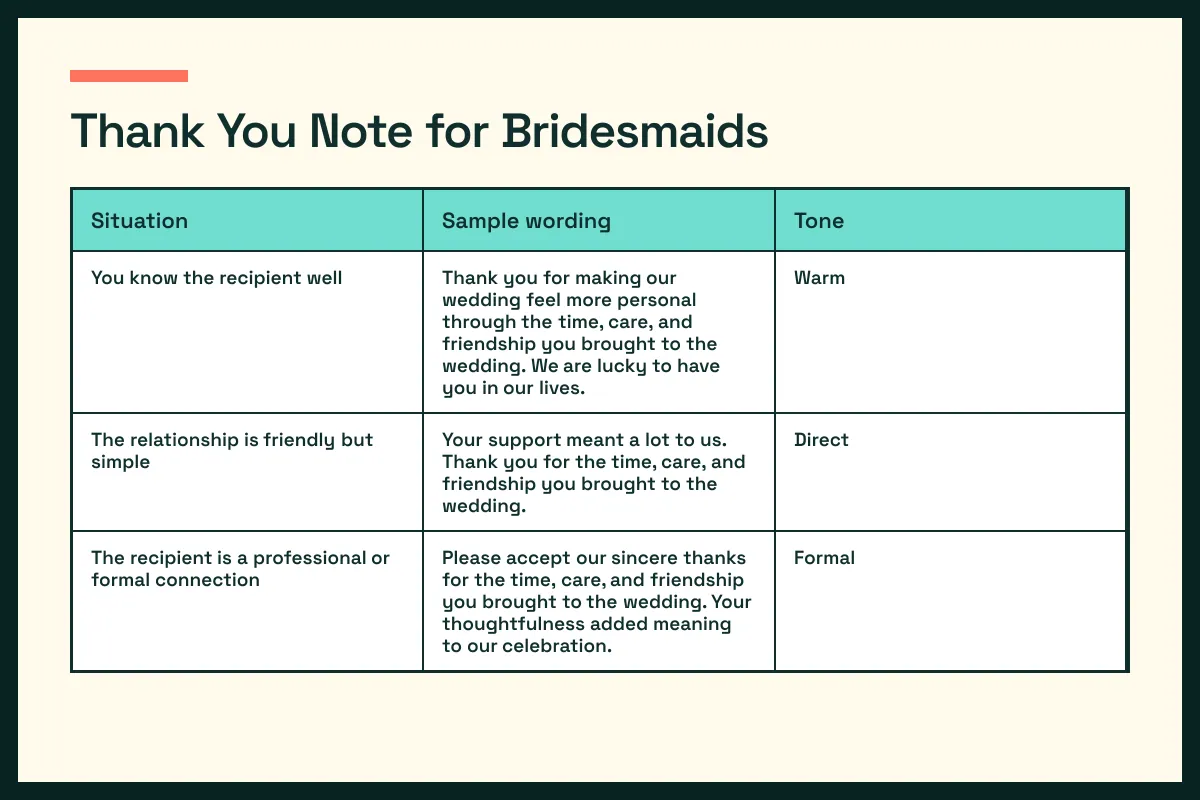
| Situation | Sample wording | Tone |
|---|---|---|
| You know the recipient well | Thank you for making our wedding feel more personal through the time, care, and friendship you brought to the wedding. We are lucky to have you in our lives. | Warm |
| The relationship is friendly but simple | Your support meant a lot to us. Thank you for the time, care, and friendship you brought to the wedding. | Direct |
| The recipient is a professional or formal connection | Please accept our sincere thanks for the time, care, and friendship you brought to the wedding. Your thoughtfulness added meaning to our celebration. | Formal |
| The card is delayed | Our thanks are overdue, but our appreciation for the time, care, and friendship you brought to the wedding is sincere. | Brief and honest |
Warm
Thank you for making our wedding feel more personal through the time, care, and friendship you brought to the wedding. We are lucky to have you in our lives.
We felt very loved when we received the time, care, and friendship you brought to the wedding. It means a great deal to begin this chapter with your support.
Every time we think about a private moment the couple or bride shared with the recipient, we think of you. Thank you for the time, care, and friendship you brought to the wedding.
Your kindness came through so clearly in the time, care, and friendship you brought to the wedding. Thank you for helping us remember the way the recipient showed up before and during the celebration.
We were so happy to receive the time, care, and friendship you brought to the wedding. We keep thinking about a private moment the couple or bride shared with the recipient, and we are grateful you were part of it.
Direct
Your support meant a lot to us. Thank you for the time, care, and friendship you brought to the wedding.
We appreciate the time, care, and friendship you brought to the wedding. It was thoughtful, useful, and unmistakably from you.
Thank you for the time, care, and friendship you brought to the wedding. We especially appreciate the practical help and emotional presence the person offered.
Thank you for celebrating with us and for the time, care, and friendship you brought to the wedding. We will remember your kindness.
We are grateful for the time, care, and friendship you brought to the wedding and for the thought behind it.
Formal
Please accept our sincere thanks for the time, care, and friendship you brought to the wedding. Your thoughtfulness added meaning to our celebration.
We are deeply grateful for the time, care, and friendship you brought to the wedding and for the care you showed us.
Thank you for your generous and thoughtful support of our marriage. We greatly appreciate the time, care, and friendship you brought to the wedding.
It was a pleasure to celebrate with you. Please know how much we value the time, care, and friendship you brought to the wedding.
With warm appreciation, we thank you for the time, care, and friendship you brought to the wedding and for sharing in this occasion.
how to thank bridesmaids
how to thank bridesmaids and groomsmen
how to thank bridesmaids for wedding
what to write in bridal party thank you cards
A strong thank you note for bridesmaids names the kindness, adds a detail only this recipient would recognize, and closes in the couple’s natural voice. The note does not need to be long. It needs to be true.
The central detail for this situation is the practical help and emotional presence the person offered. Keep that detail visible so the wording does not collapse into a generic “thank you for everything.”
What should the note say first?
Start with the person’s name and the specific gift, action, presence, or support. The opening should let the recipient know immediately that the card was written for them.
Then add why it mattered. Use a private moment the couple or bride shared with the recipient if it fits. A concrete memory proves attention without turning the note into a full retelling of the wedding.
Close with affection or appreciation that matches the relationship. Formal language can suit a professional or distant connection. Warm language may fit family and close friends. Direct language works when the couple’s usual voice is simple.
How can you personalize the wording?
Replace the general noun with the real detail. Name the object, contribution, task, journey, or moment when it is appropriate and verified. If the giver or contribution is uncertain, confirm it before writing.
Add one sentence no other recipient will receive. It might recall a conversation, the way the person helped, a moment you noticed during the celebration, or how the gift will enter the couple’s real life.
Do not invent a use. If the couple has not decided what happens next, thank the person for the thought and flexibility instead.
When should you send the card?
Write and send it as soon as you can make it accurate. The project data provides no fixed deadline for this page, so the article does not publish one.
Delay is a reason to simplify the workflow, not to abandon the note. Confirm the recipient, choose a line from the appropriate tone, add the personal detail, review both names, and send it.
Use a shared tracker for status only. Keep private addresses and sensitive gift information in a protected place.
Which tone should you choose?
Warm wording centers the relationship. Direct wording centers the action or gift. Formal wording centers respectful appreciation. Choose one tone, then adjust it until it sounds like the couple.
What should you not write?
Do not send the same copied praise to every person, list duties like a performance report, or use a joke that embarrasses the recipient.
Avoid exaggerated praise that makes a modest but meaningful gesture sound unbelievable. Do not turn the card into a wedding report or a request for another action.
A thank-you note should not settle a conflict. If a service, gift record, or relationship issue remains unresolved, handle that conversation separately and keep the card honest.
How can you adapt the templates?
Choose the closest template, replace the situation language, and add the recipient-specific sentence. The examples are sentence parts, not scripts that must stay intact.
How do you check the card before sending?
Verify the recipient’s name, the gift or action, the personal detail, and the signers. Make sure the envelope and tracker match the card.
Check that the note does not reveal a contribution amount or compare people. Remove jokes that depend on the recipient accepting embarrassment.
Then mark the task sent, not complete, only after the card has actually left the couple’s hands.
What makes this message different from the next one?
This page focuses on the practical help and emotional presence the person offered. The next recipient deserves a new detail. Reusing the tone is fine; reusing the entire memory is not.
Think of the template as a frame. The personal sentence is the picture.