
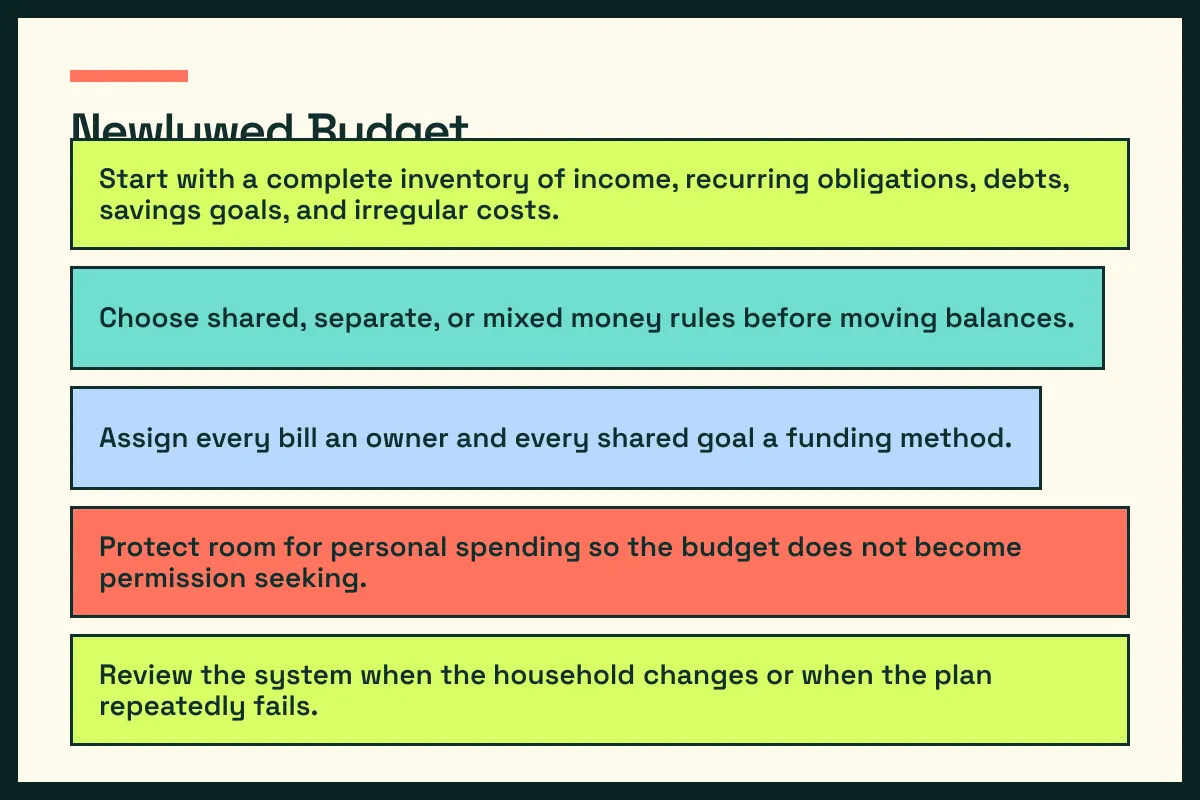
- Start with a complete inventory of income, recurring obligations, debts, savings goals, and irregular costs.
- Choose shared, separate, or mixed money rules before moving balances.
- Assign every bill an owner and every shared goal a funding method.
- Protect room for personal spending so the budget does not become permission seeking.
- Review the system when the household changes or when the plan repeatedly fails.
- 1List all household income sources and recurring obligations.
- 2Add irregular costs and unfinished wedding expenses.
- 3Choose what is shared and what remains personal.
- 4Assign an owner and funding source to every bill.
- 5Name shared savings goals and individual priorities.
- 6Create a simple review and correction routine.
- 7Test the budget, record problems, and revise the rules.
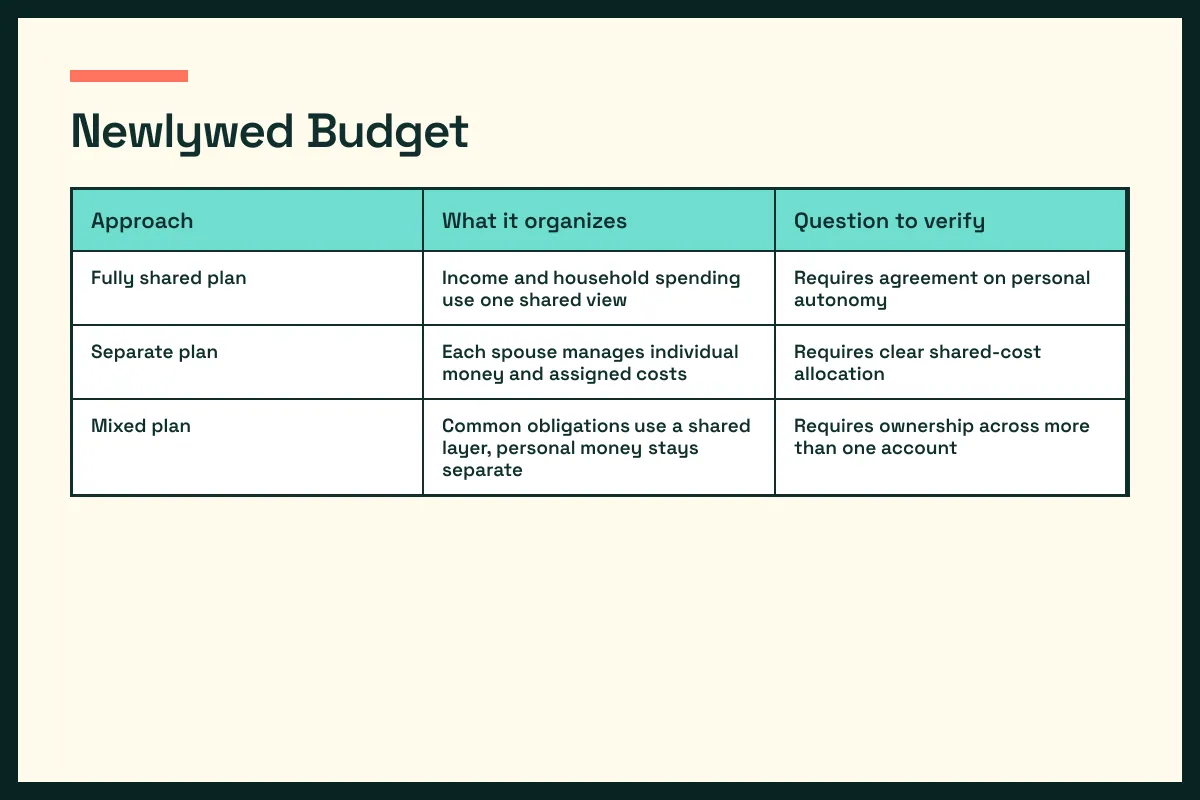
| Approach | What it organizes | Question to verify |
|---|---|---|
| Fully shared plan | Income and household spending use one shared view | Requires agreement on personal autonomy |
| Separate plan | Each spouse manages individual money and assigned costs | Requires clear shared-cost allocation |
| Mixed plan | Common obligations use a shared layer, personal money stays separate | Requires ownership across more than one account |
newlywed budget template
newlywed budget
newlywed budget excel spreadsheet
dave ramsey newlywed budget
how do couples combine finances
A newlywed budget is less about arithmetic than agreement. Two people can use the same spreadsheet and still disagree about which costs are shared, who notices a missed payment, or how much personal freedom the plan should preserve.
Build the operating rules before optimizing categories. The budget should show real obligations, a responsible owner, a funding source, and a way to repair the plan when life does not match the worksheet.
What should a newlywed budget include?
List income sources, recurring household obligations, debts, savings goals, irregular costs, and unfinished wedding expenses. Use the couple’s actual records rather than estimates presented as settled facts.
For each item, record who owns the account or obligation, who pays it in the household plan, and whether the other spouse needs access or visibility. Ownership and payment responsibility may differ.
Keep sensitive values in a secure budget file. A shared task list can show status and ownership without exposing account credentials.
How should couples define a shared expense?
Ask whether the expense serves the household, one spouse, or a separate obligation. Then agree on how it will be funded. Do not rely on assumptions such as “groceries are shared, subscriptions are personal” unless both people accept the rule.
Discuss ambiguous areas: family support, work expenses, hobbies, gifts, health needs, travel, pets, and prior commitments. The categories are prompts, not universal classifications.
Write the result. An explicit imperfect rule can be reviewed; an invisible assumption cannot.
Which money structure can support the budget?
A fully shared approach places household income and spending in one view. It can simplify visibility, but it needs fair rules for personal purchases and access.
A separate approach keeps individual control while assigning shared costs. It can preserve autonomy, but the funding method must be dependable and understandable.
A mixed approach uses a shared layer for common obligations and personal layers for individual spending. It may balance visibility and autonomy, while requiring more careful ownership.
Choose the structure after defining the budget rules. Do not expect an account product to create agreement.
How should couples assign bills?
Give each recurring obligation a primary owner. That person monitors the due state, investigates a problem, and records the outcome. The other spouse should know how to find essential information if the owner is unavailable.
Ownership should reflect capacity and access, not gender or habit. Rebalance the list if one person becomes the permanent administrator for every household system.
Create a backup plan for essential bills. Do not store passwords in an ordinary checklist; use a secure access method chosen by the couple.
What belongs in the personal-spending conversation?
Decide what each spouse may spend independently and which purchases require discussion. The goal is not surveillance. It is to prevent one person’s private choice from quietly consuming money promised to a shared obligation.
Personal amounts can differ if both spouses understand and accept the reason. Fairness does not always mean identical categories.
Keep gifts and surprises possible without turning secrecy into a financial system. Agree on how those purchases fit the plan.
How should a couple plan for irregular costs?
Create a list of costs that do not appear every month but can still be anticipated: maintenance, travel, family events, annual services, household replacement, or professional help. Do not assign amounts without real records.
Give each item a review status and a possible funding source. When a cost becomes clear, update the budget from evidence.
Separate a true surprise from an irregular but expected category. The distinction helps the couple learn from the first year rather than repeatedly calling the same expense unexpected.
Can a spreadsheet solve the problem?
A spreadsheet can organize information, but only if both spouses understand the categories and know which version is current. A complex workbook controlled by one person may reduce shared understanding.
Use fields that answer decisions: owner, funding source, due state, shared or personal, and needs review. Add calculations only when both people can explain them.
Protect the file. Keep account credentials and identity records elsewhere.
How should spouses discuss debt?
List obligations accurately and identify the legal owner. Discuss how payments affect shared goals without assuming that household support changes account ownership.
Avoid blame language. Ask what the obligation requires, what the current plan can support, and where qualified advice is needed.
Do not refinance, transfer, consolidate, or open an account based on a general budgeting article. Those actions require provider terms and individual evaluation.
What should happen during a budget review?
Compare the plan with what actually happened. Look for missed ownership, categories that were unrealistic, expenses that remained invisible, and rules that created resentment.
Fix the system rather than prosecuting the person. Reassign work, simplify categories, change the funding method, or revise the personal boundary.
End with named actions. A budget conversation that produces only concern will return in the same form.
How can the budget support shared goals?
Name the goal, the reason it matters, the owner of tracking, and how progress will be reviewed. Keep the goal separate from the account used to fund it.
Allow individual priorities alongside shared goals. Marriage does not require every ambition to merge.
When goals compete, return to timing, household capacity, and the couple’s stated values. Seek qualified financial advice when the tradeoff involves debt, investment, tax, or legal consequences.
What makes the first-year system durable?
Build a short change log beside the budget. When a category, owner, or funding rule changes, record what problem prompted the change and which spouse will check the result. This stops an old assumption from returning after the spreadsheet has been edited.
Keep disagreements visible without turning them into permanent labels. “Travel amount needs review” is actionable. “You always overspend” is not a budget field and will not tell the couple what rule to change.
If the budget depends on a tax, debt, investment, insurance, or legal assumption, mark it for qualified review. Do not hide the assumption inside a formula that only one spouse understands.
Agree on how corrections enter the shared file. One spouse can maintain the worksheet, but both should know how to flag a wrong category, missing obligation, or outdated owner. Record the decision before changing historical entries.
Both spouses can explain it. Essential obligations have owners. Personal autonomy has a boundary. The plan changes when facts change.
Keep the review short enough to repeat and detailed enough to catch a real problem. Archive old versions so a changed assumption does not look like a missing promise.
A successful newlywed budget is not a perfect forecast. It is a repairable agreement.