
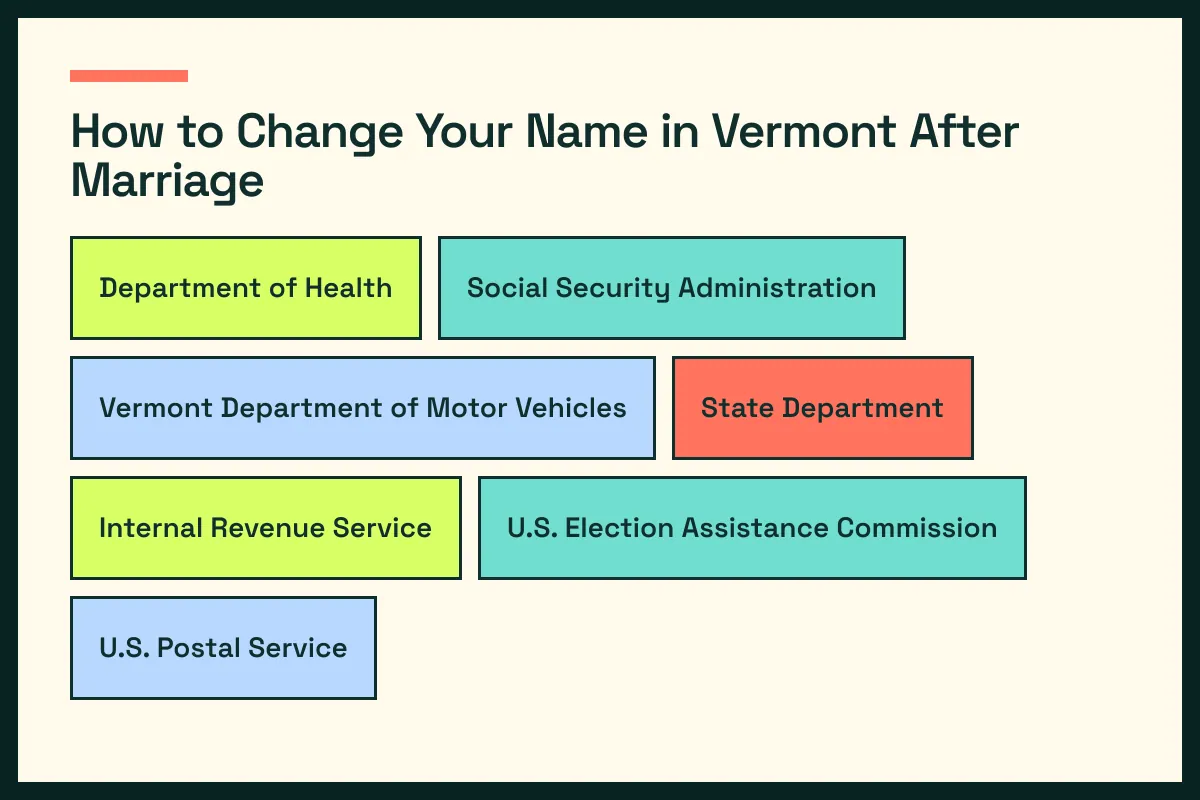
- Marriage-record source: Department of Health.
- Driver-record source: Vermont Department of Motor Vehicles.
- Voter source: Elections Division.
- Certified-copy routing is source-backed; saved methods: online, phone.
- 1Confirm the legal name you intend to use.
- 2Open the saved vital-record source and identify the evidence task.
- 3Verify the certified-copy route only where the state data supports it.
- 4Open the named driver source and follow its current instruction.
- 5Submit only through a channel the responsible source identifies.
- 6Check voter registration through its separate official source.
- 7Save each outcome and leave unresolved records open.
| Record owner | Task | Saved page type |
|---|---|---|
| Department of Health | Marriage-record evidence | procedure |
| Vermont Department of Motor Vehicles | Driver-license record | procedure |
| Elections Division | Voter registration | procedure |
how to change your name in vermont after marriage
how to change your last name after marriage in vermont
how to change my name in vermont
how to change my last name in vermont
Vermont and federal records belong to different systems. This page stays with the state-level evidence saved for marriage records, the named driver agency, and the official voter source.
Each Vermont destination was verified independently. The stored labels and link types organize the work; the live record owner answers anything absent from the structured data.
Where should a Vermont name change begin?
Department of Health is the vital-record label preserved for Vermont. The evidence points to a procedure page. Read the live instruction before requesting or presenting any record.
Before leaving the vital-record source, note the action it supports. The saved link is research evidence; the response from Department of Health is the state-specific outcome.
What does the data say about certified copies?
The certified-copy evidence supports a state-office route for Vermont. The saved methods are online, phone. Use the vital-record source to confirm which method fits the record and request you have.
This section follows the state record literally. It never upgrades a contact page into an issuer or turns a supported local route into a generic state claim.
How do you handle the driver-license record?
Vermont Department of Motor Vehicles is the driver-record agency stored for Vermont. Its link is classified as procedure. Use it for the license question and do not import a form or rule from another state.
No driver deadline is stored for Vermont. Let Vermont Department of Finance and Administration provide current timing and preparation details, then record its answer without manufacturing urgency.
Where do you verify voter registration?
The voter row points to Elections Division. Its URL is classified as procedure. Check that source for registration information and avoid assuming that a license update changes the voter record.
Do not inherit completion from the driver row. The voter source supplies its own result beside the registration task.
What is the seven-step workflow?
Use seven distinct statuses: evidence identified, source checked, materials preparing, request submitted, response received, correction needed, and complete. The labels keep preparation from being mistaken for an agency outcome.
The checklist is sequential for clarity, not a promise that every reader uses one channel. Preserve each source’s live dependency.
What can you do if a request is rejected?
Keep refusals and incomplete responses with the record owner. Ask for the exact unsatisfied requirement before sending more personal material or changing service channels.
Protect the next submission by narrowing it. More documents are not better when the response has not named the missing requirement.
Why are neighboring state pages not interchangeable?
The related state guides are Maine, Massachusetts, New Hampshire, New York. They support orientation and site browsing, not a Vermont requirement. Office names, URL types, copy routes, and stored methods can differ.
Related links improve discovery, not authority. Reopen the saved Vermont destination before acting on a local record.
How should you use the source table?
The table prevents source drift. Its Vermont links are drawn from the structured record and are the only external destinations authored into this page. Keep the Department of Health, Vermont Department of Finance and Administration, and voter responses under their matching rows. A useful page from another office remains outside the evidence set until verified.
How do you close the Vermont checklist?
Finish Vermont as three independent rows. The marriage source, Vermont Department of Finance and Administration, and voter source each need an outcome before their row closes.
The outcome is a verifiable trail, not a claim that every organization knows the name. Continue only where another record still needs work.