
- Marriage-record source: State Health Services.
- Driver-record source: Texas Department of Public Safety.
- Voter source: Elections and Voting.
- Certified-copy routing is source-backed; saved methods: online, mail, in-person, phone.
- 1Confirm the legal name you intend to use.
- 2Open the saved vital-record source and identify the evidence task.
- 3Verify the certified-copy route only where the state data supports it.
- 4Open the named driver source and follow its current instruction.
- 5Submit only through a channel the responsible source identifies.
- 6Check voter registration through its separate official source.
- 7Save each outcome and leave unresolved records open.
| Record owner | Task | Saved page type |
|---|---|---|
| State Health Services | Marriage-record evidence | procedure |
| Texas Department of Public Safety | Driver-license record | procedure |
| Elections and Voting | Voter registration | procedure |
how to change your name in texas after marriage
how to change your name in texas after marriage online
how to change last name in texas after marriage
how to change last name in texas after marriage online
A marriage record does not update every Texas system by itself. The useful plan is to identify the evidence source, open the correct driver service, and verify the voter record through its own official page.
Texas has separate evidence for marriage records, driver licensing, and voter registration. Keeping those sources apart prevents a detail from one system becoming a claim about another.
Where should a Texas name change begin?
Open the saved procedure page for State Health Services first. Record what the source actually allows and leave any absent requirement out of the task.
Treat this stage as evidence preparation. Record the instruction from State Health Services, protect the documents, and do not mark the task finished merely because the page opened.
What does the data say about certified copies?
For certified copies, the structured record identifies a county-clerk route. It also preserves online, mail, in-person, phone as methods. Keep the issuer evidence tied to this state instead of applying the same route elsewhere.
Read the issuer value and methods separately. One names a supported route when present; the other records ways the source says a request may be handled.
How do you handle the driver-license record?
Move to Texas Department of Public Safety only when you are ready to handle the license as its own record. Read the procedure page and use the agency’s current wording.
The license task has a named owner but no saved deadline. That tells you where to ask, not what date to publish.
Where do you verify voter registration?
Voter registration has its own official source: Elections and Voting. The project classifies the link as procedure; it does not claim that another name update reaches this system.
Registration is a third state record, not a byproduct of the first two. Verify it where Texas directs voters.
What is the seven-step workflow?
Work in small handoffs. Finish the question for one record, preserve the result, and then open the next source. This prevents requirements from different systems from being mixed.
Keep the order flexible when one owner requires an earlier record, but keep statuses precise. A waiting dependency belongs on the list.
What can you do if a request is rejected?
If a request is not accepted, read the response and identify which record, item, or channel it addresses. Compare that point with the saved source and ask the same owner what correction is allowed.
A refusal does not justify trying every channel. Ask what failed, correct that point, and use only a route the source authorizes.
Why are neighboring state pages not interchangeable?
The related state guides are Arkansas, Louisiana, New Mexico, Oklahoma. They are useful for orientation and site browsing, not as evidence for a Texas requirement. Office names, URL types, copy routes, and stored methods can differ.
Cross-state browsing is orientation only. Fees, timing, documents, and issuers stay state-specific unless Texas evidence says otherwise.
How should you use the source table?
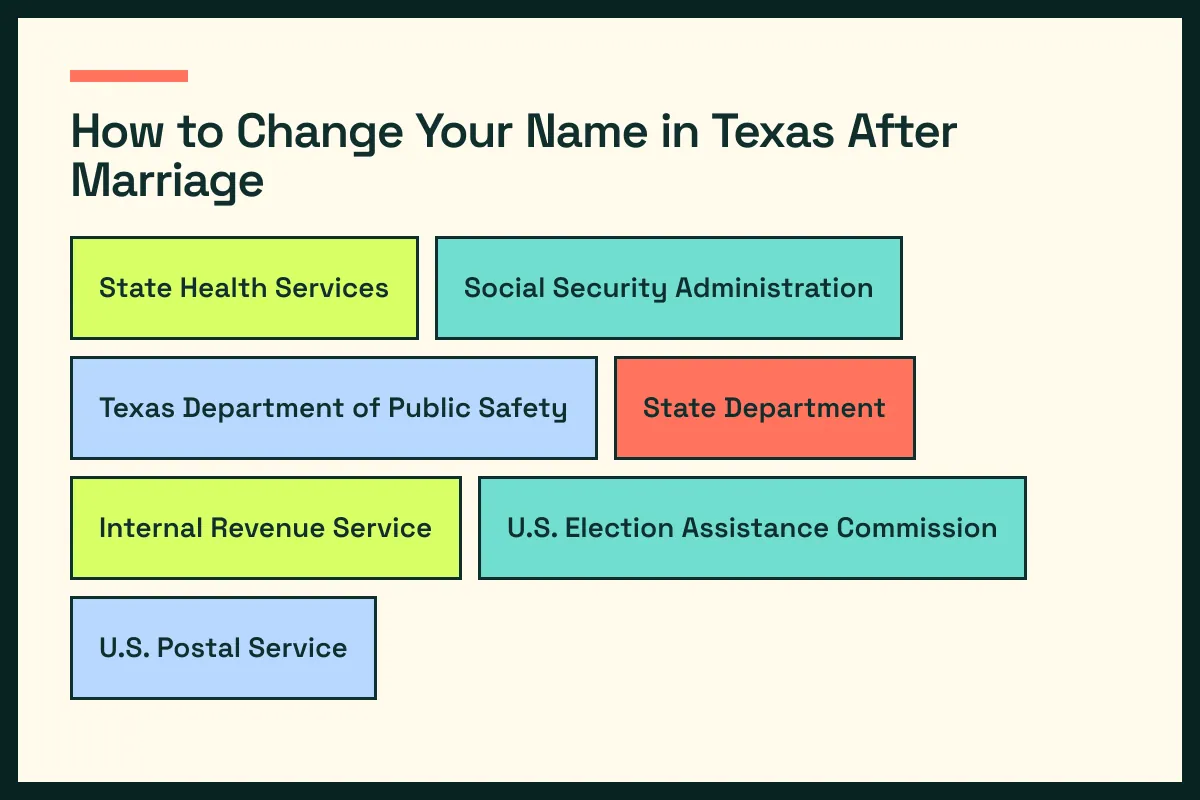
Use the linked table as a routing map. Begin with State Health Services for the marriage-record stage, move to Texas Department of Public Safety for the license record, and keep the voter destination separate. The visible label, saved URL, and page classification travel together. Do not detach one label and apply it to another record.
How do you close the Texas checklist?
Use record-specific completion language. One broad “updated” status can hide an unfinished Texas system.
The practical end point is clarity. Both spouses can see remaining work without mistaking an announcement for an updated state record.