
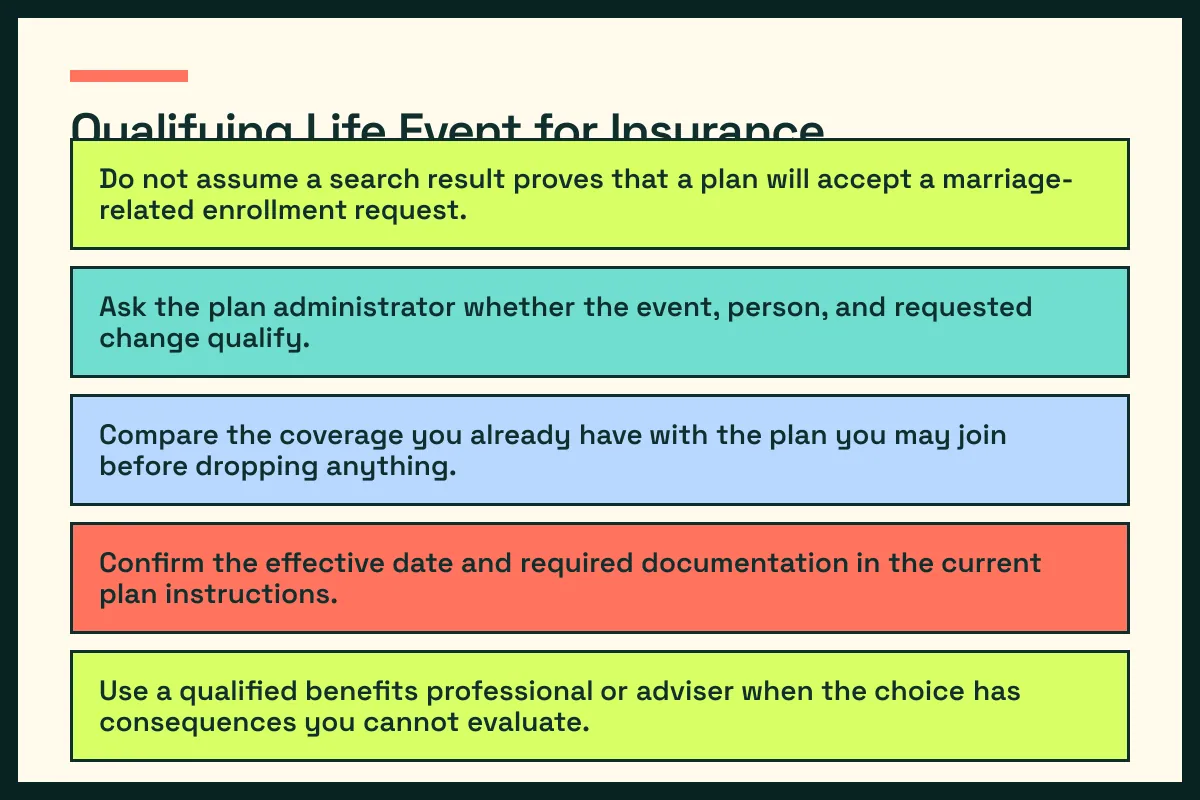
- Do not assume a search result proves that a plan will accept a marriage-related enrollment request.
- Ask the plan administrator whether the event, person, and requested change qualify.
- Compare the coverage you already have with the plan you may join before dropping anything.
- Confirm the effective date and required documentation in the current plan instructions.
- Use a qualified benefits professional or adviser when the choice has consequences you cannot evaluate.
- 1Identify every current health plan covering either spouse.
- 2Ask each administrator whether the marriage event supports the requested change.
- 3Request the current enrollment instruction and document list.
- 4Compare providers, prescriptions, services, dependents, and member access.
- 5Confirm when any new coverage would take effect.
- 6Avoid ending existing coverage before the replacement is confirmed.
- 7Save the decision, confirmation, and unresolved questions.
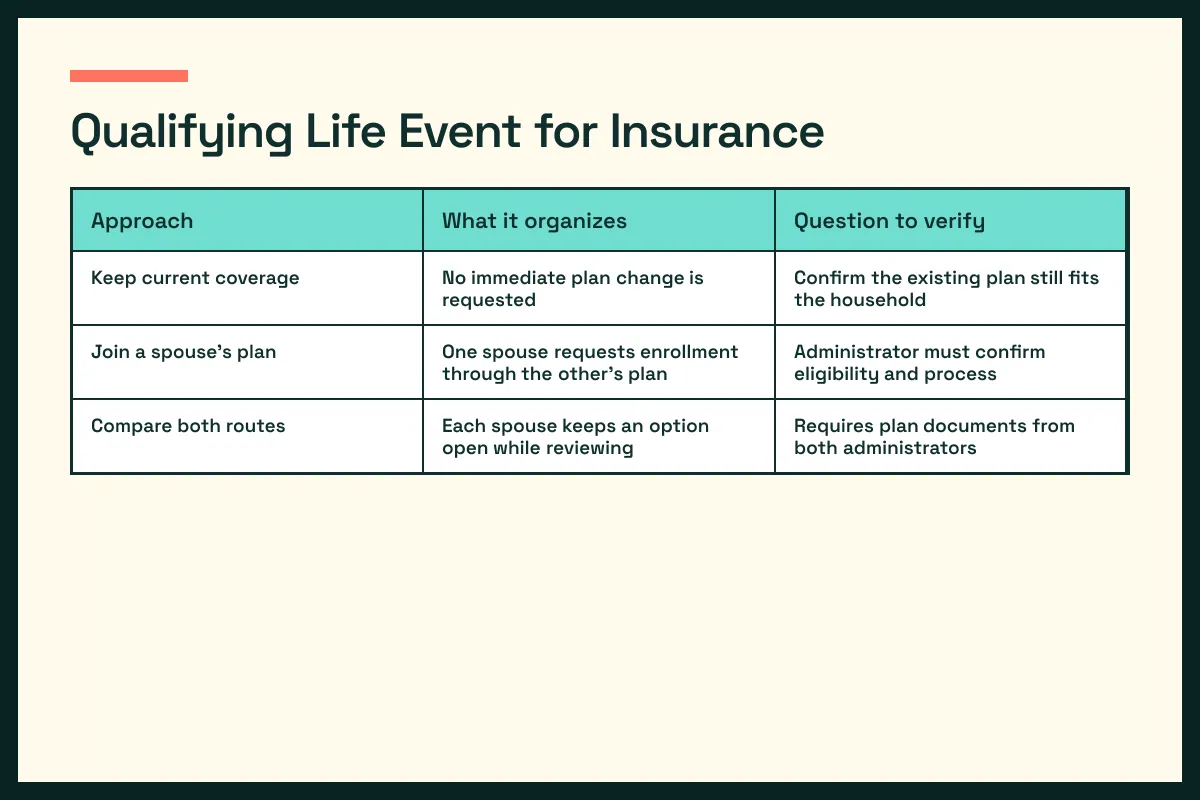
| Approach | What it organizes | Question to verify |
|---|---|---|
| Keep current coverage | No immediate plan change is requested | Confirm the existing plan still fits the household |
| Join a spouse's plan | One spouse requests enrollment through the other's plan | Administrator must confirm eligibility and process |
| Compare both routes | Each spouse keeps an option open while reviewing | Requires plan documents from both administrators |
qualifying life event for insurance
qualifying life event for insurance change
qualifying life event for insurance pregnancy
qualifying life event for insurance enrollment
qualifying life event for insurance documentation requirements
A qualifying life event for insurance is useful only when the plan administrator confirms what it means for the requested change. Marriage may be the event you are reporting, but the practical questions are plan-specific: who may enroll, which change is allowed, what evidence is accepted, and when coverage would begin.
Do not compare plan names alone. Compare what each spouse can actually use, what remains uncertain, and what must be confirmed before existing coverage changes.
Who should confirm the insurance event?
Start with the administrator of each plan that could cover either spouse. Describe the marriage event and the exact enrollment or coverage change being considered. Ask whether that request qualifies under the current plan.
Keep the response with the plan name and the spouse connected to it. A general benefits article or another employee’s experience cannot prove that the same rule applies.
If the administrator points to a plan document, read the section it names. Save the current version or note where it can be retrieved again.
What information should you collect before comparing plans?
List the services, providers, prescriptions, and member needs that matter to each spouse. This is a personal inventory, not a prediction about coverage. It gives you a set of questions for each plan.
Record current coverage and any known appointments or ongoing care without placing private medical details in a shared planning document. The household checklist can say “provider access to confirm” or “prescription coverage to verify.”
Include dependents only where relevant to the household decision. Ask the administrator how the requested change applies to each person rather than assuming one answer covers everyone.
How should you compare provider access?
Ask each plan whether the providers and facilities you intend to use are covered under the plan option being considered. Confirm through the plan’s current directory or administrator. A provider’s own website may not answer the exact plan question.
Check access by service, not only by organization name. A facility can host different professionals and services, while a plan can distinguish among them. Keep unresolved items visible.
If continuity of care matters, ask the administrator which process applies. This guide cannot determine an individual medical or coverage outcome.
What should you ask about prescriptions and services?
Bring the exact prescription or service question to the plan. Ask whether it is covered, what member action is required, and which limits or approvals appear in the current plan document.
Do not substitute one medication or service for another in the checklist. The purpose is to compare the real household need, not a broad category that hides an important difference.
If the answer affects treatment, discuss it with the relevant clinician and benefits professional. This article does not give medical advice or recommend changing care.
Why does the effective date matter?
Coverage decisions need a confirmed start point. Ask the administrator when the requested enrollment would become effective and what must happen before that date is valid.
Keep existing coverage in place until you have a reliable confirmation for the replacement decision. This is a planning safeguard, not a claim about how any particular plan coordinates termination.
Record the effective date exactly as the plan provides it. Do not estimate from the submission date or another person’s enrollment.
Which documents should you prepare?
Use only the documentation list supplied by the administrator for the event and requested change. The project data does not contain a universal list, so the guide does not name marriage records, identity records, or employment records as automatic requirements.
Ask how documents should be submitted and protected. A general benefits inbox may not be the correct destination for sensitive personal information.
Track “requested,” “ready,” “submitted,” and “confirmed” as separate statuses. A prepared document does not prove enrollment.
How can spouses compare cost without guessing?
Request the current member-cost information for each plan option. Compare the categories the plans provide rather than relying on a remembered premium or an unsourced estimate.
Consider how regular contributions, point-of-care costs, prescriptions, and expected services appear in the plan materials. This page does not calculate which option is cheaper or better for a household.
If the tradeoff is hard to evaluate, ask a qualified benefits professional to explain the plan documents. Keep the decision tied to current written information.
What can you do if enrollment is denied or incomplete?
Read the administrator’s response and identify whether the issue concerns event eligibility, the requested change, documentation, timing, or the person being enrolled. Compare that point with the instruction you followed.
Ask what correction or review process the plan provides. Do not send additional sensitive records until the administrator explains what is missing.
If urgent care or medication access is affected, contact the plan and the relevant care professional directly. A general website cannot manage an individual coverage interruption.
How should you record the final decision?
Create a side-by-side question sheet for the administrators. Use the same categories for each plan: event eligibility, person to enroll, documents, effective date, provider access, prescription questions, member costs, and confirmation method. Leave an item blank when the plan has not answered it.
Compare only like information. A confirmed answer from one administrator should not be placed beside an assumption about another plan as if both were settled. Return incomplete rows to the responsible plan.
Mark every answer with its source inside the plan. A directory result, member document, administrator message, and clinician conversation answer different questions. Keeping the source visible prevents one reassuring statement from being stretched beyond its scope.
If the administrators use different terms, preserve their wording and ask what each term means for the requested enrollment. Do not normalize distinct plan language into a shared promise.
Unanswered terms remain open questions.
Before acting, ask each spouse to explain the selected coverage and remaining limits in their own words. If either person cannot explain the choice, the worksheet still contains an unresolved question. Seek benefits help before replacing coverage on the basis of a vague comparison.
Write which coverage each person will use, the confirmed effective date, and who owns follow-up. Keep the supporting plan response in secure storage.
List remaining questions separately. A decision can be made while a card, directory listing, or account display is still pending, but the pending item should not disappear.
Revisit the plan when household or employment circumstances change. Ask the administrator again rather than assuming the earlier event instruction still controls.