
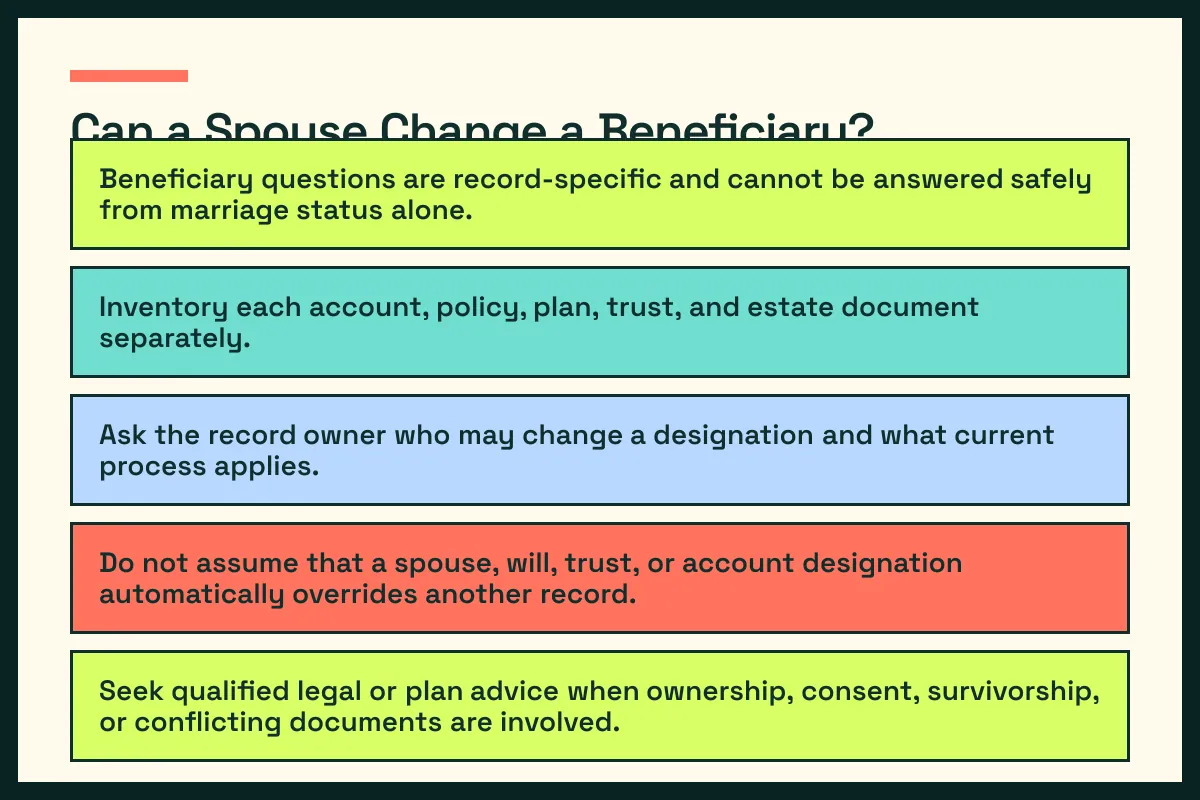
- Beneficiary questions are record-specific and cannot be answered safely from marriage status alone.
- Inventory each account, policy, plan, trust, and estate document separately.
- Ask the record owner who may change a designation and what current process applies.
- Do not assume that a spouse, will, trust, or account designation automatically overrides another record.
- Seek qualified legal or plan advice when ownership, consent, survivorship, or conflicting documents are involved.
- 1List every record that contains or may contain a beneficiary designation.
- 2Name the institution, plan, policy, trust, or document that owns each record.
- 3Identify who can currently access and change the record.
- 4Request the owner's current change and consent rules.
- 5Compare the saved designation with the couple's stated intent.
- 6Send no change until individual legal or plan questions are resolved.
- 7Save confirmations and schedule a future review.
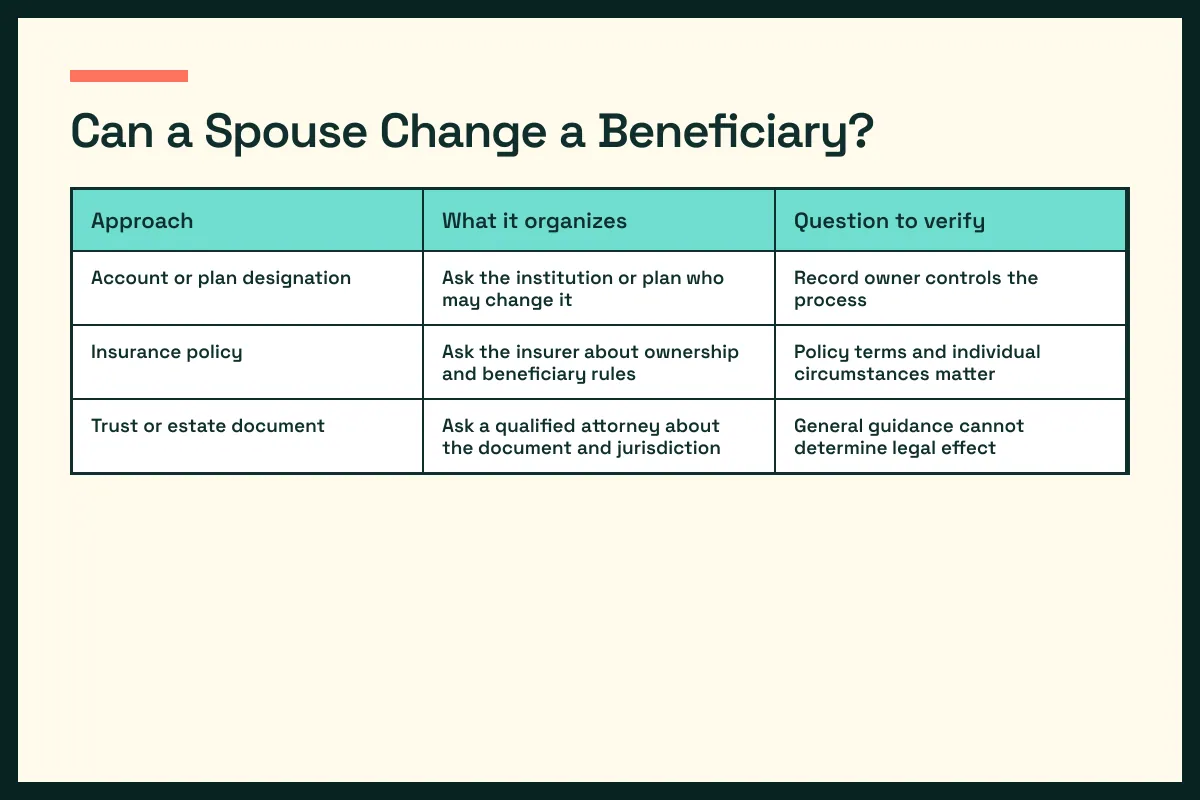
| Approach | What it organizes | Question to verify |
|---|---|---|
| Account or plan designation | Ask the institution or plan who may change it | Record owner controls the process |
| Insurance policy | Ask the insurer about ownership and beneficiary rules | Policy terms and individual circumstances matter |
| Trust or estate document | Ask a qualified attorney about the document and jurisdiction | General guidance cannot determine legal effect |
can a spouse change beneficiary
can spouse change beneficiary on life insurance policy
can a surviving spouse change beneficiary in a revocable trust
can a spouse override a beneficiary
can a spouse override a beneficiary on a life insurance policy
“Can a spouse change a beneficiary?” is not one question until the record is named. A beneficiary may appear on an account, policy, plan, trust, or estate document, and the project data provides no rule saying those records work alike.
The safe first move is an inventory. Identify the record owner, the current designation, the person who has change authority, and any question that requires legal or plan-specific advice.
Which beneficiary records should enter the review?
List every account, policy, workplace plan, trust, and estate document that may contain a beneficiary or transfer instruction. Use the names shown by the record owners rather than combining them under “beneficiaries.”
Record whether the designation is known, unknown, or needs confirmation. Do not rely on memory. A spouse may remember completing a form without knowing whether it remains current.
Keep account numbers and private documents out of the shared checklist. The list needs the record type, owner, status, and next action.
Who owns the answer for each record?
The institution, insurer, plan administrator, trustee, or document professional connected to the record should provide its current process. This page does not invent one universal beneficiary form or authority rule.
Ask who may view the designation, who may change it, whether another person’s consent is relevant, and how the owner confirms a completed change. Phrase these as questions until the responsible source answers.
For a trust or estate document, seek a qualified attorney. The legal effect can depend on the document and jurisdiction, which are absent from this general guide.
How should you review a life insurance beneficiary?
Start with the policy and insurer. Ask who owns the policy and who has authority to request a beneficiary change. Do not assume that the insured person, policy owner, spouse, and beneficiary are interchangeable roles.
Confirm the current designation through the insurer’s process. Then compare it with the policy owner’s intent. If ownership, consent, or spouse rights are unclear, pause before submitting a change.
Keep the insurer’s response with the policy record. A search snippet cannot decide the policy.
What should you ask about a workplace or retirement plan?
Ask the plan administrator how to view the current designation, who may change it, and which plan terms or consent rules apply. The protected search evidence includes spouse-override questions, but the page data contains no plan-specific answer.
Do not transfer an answer from an insurance policy to a workplace plan. Even if both records use the word “beneficiary,” their governing terms may differ.
If a legal or tax consequence matters, bring the plan document and current designation to a qualified professional.
Can a will or trust answer every beneficiary question?
Do not assume that it can. This page has no evidence establishing how a will, trust, policy, or account designation interacts in an individual case.
Place each document in the inventory and ask the appropriate professional how it relates to the others. Record conflicts as unresolved until reviewed.
Avoid “my will covers everything” as a status. Replace it with the name of the document, the professional consulted, and the specific records reviewed.
How should spouses discuss the intended outcome?
Each spouse can state whom they intend to benefit and why, but intention should not be confused with a completed record. Compare the stated intention with every verified designation.
Discuss contingent situations without turning them into predictions. Ask what should happen if a named person cannot receive the benefit or if household relationships change. Take those questions to the record owner or attorney.
Respect individual ownership and privacy. Marriage does not authorize one spouse to access or change every record, and this guide does not claim otherwise.
What can you do when records conflict?
Stop before making piecemeal changes. Name the records that appear inconsistent and gather their current terms or copies. Ask a qualified attorney or plan professional which rules control.
Do not choose an answer by document date, account value, or the confidence of a family member. Those details may matter, but only a qualified review can determine how.
Record the advice and the scope of the review. A professional answer about one policy should not be applied automatically to another account.
What should you verify after submitting a change?
Use confirmation from the record owner. Check that the designation shown matches the intended person and that the owner identifies the change as complete.
A downloaded form or sent message is not a completed designation. Keep the task open until the owner provides an outcome.
Store the confirmation securely. The shared checklist can show “verified” without naming beneficiaries or exposing financial details.
When should the checklist be reviewed again?
Revisit it when the couple’s intentions, household, accounts, policies, plans, trusts, or estate documents change. This is a process rule for organization, not a claim that any event legally changes a designation.
Use the same record-by-record method. Confirm the owner, view the current entry, compare it with intent, and resolve conflicts before submitting changes.
The aim is consistency backed by each record’s own evidence.
Where does this guide stop?
Prepare a concise review packet for the attorney or record owner. Include the inventory, the name of every governing document available, the current designation status, the intended outcome, and each apparent conflict. Keep account values and unrelated personal records out of the packet unless the professional requests them.
Ask the reviewer to mark which conclusions apply to a specific record and which depend on broader law or planning. This prevents advice about one policy from becoming a household rule for every account.
After the review, translate the advice into owner-specific tasks. The insurer receives an insurance question, the plan administrator receives a plan question, and the attorney handles the legal-document question. Preserve confirmation from each owner.
Reconcile the final statuses against the original inventory. Any record without a verified outcome stays open, even if every other document now matches the couple’s intent. This last pass prevents a small old account or policy from disappearing behind a completed legal review.
It cannot determine whether a spouse may change or override a beneficiary, interpret a trust, decide policy ownership, or state which document controls. Those are individual legal and plan questions.
Use the guide to build a complete inventory and better questions. Use the record owner and a qualified attorney for the answer.