
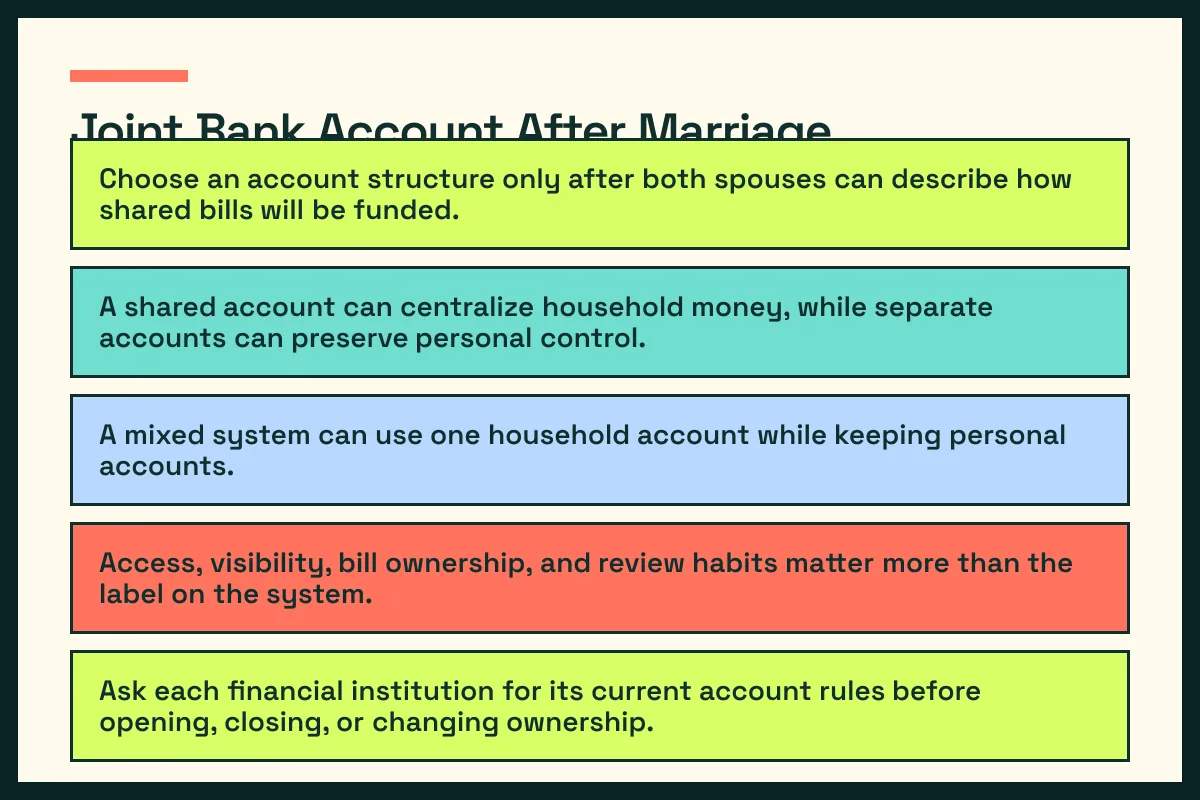
- Choose an account structure only after both spouses can describe how shared bills will be funded.
- A shared account can centralize household money, while separate accounts can preserve personal control.
- A mixed system can use one household account while keeping personal accounts.
- Access, visibility, bill ownership, and review habits matter more than the label on the system.
- Ask each financial institution for its current account rules before opening, closing, or changing ownership.
- 1List every recurring household payment and its current owner.
- 2Decide which expenses count as shared.
- 3Compare shared, separate, and mixed account structures.
- 4Agree on access, visibility, and personal spending boundaries.
- 5Assign monitoring for every bill and balance.
- 6Ask the chosen institution for its current account process.
- 7Set a review point and record what is working.
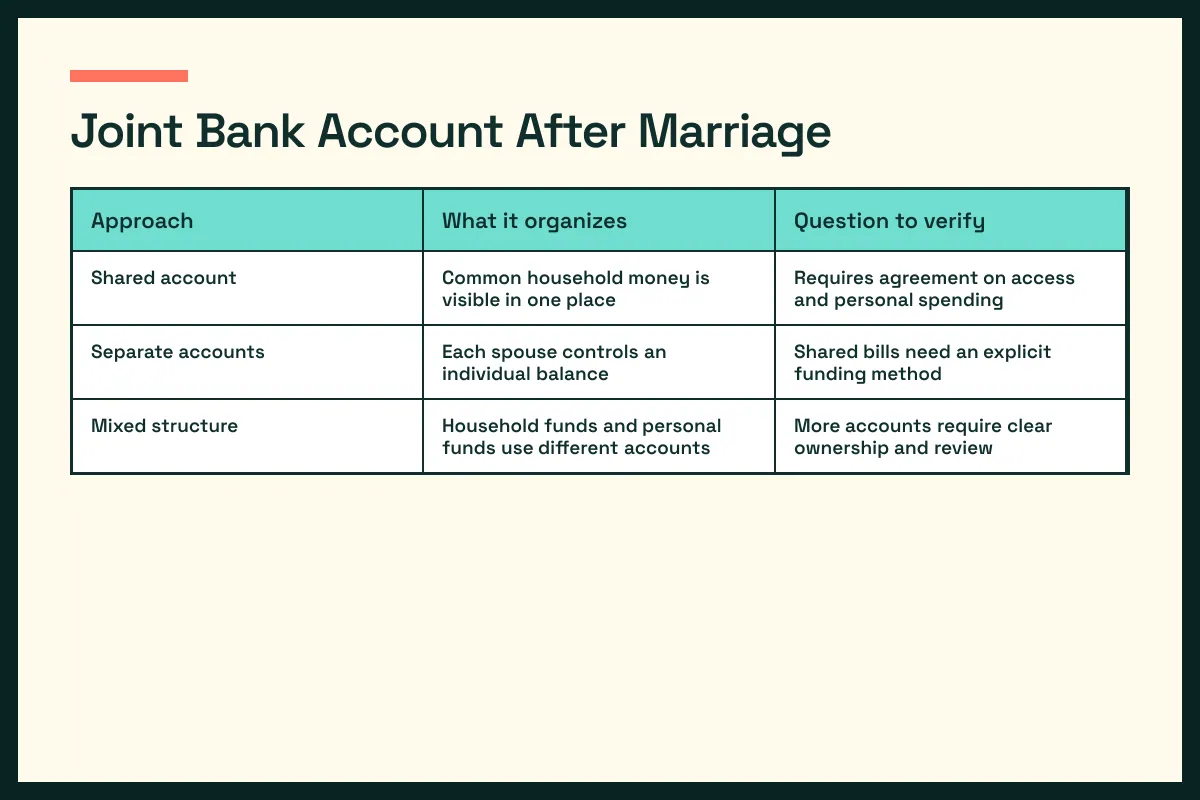
| Approach | What it organizes | Question to verify |
|---|---|---|
| Shared account | Common household money is visible in one place | Requires agreement on access and personal spending |
| Separate accounts | Each spouse controls an individual balance | Shared bills need an explicit funding method |
| Mixed structure | Household funds and personal funds use different accounts | More accounts require clear ownership and review |
joint bank account after marriage
joint bank account after marriage reddit
joint checking account after marriage
opening joint bank account after marriage
joint bank account when married
A joint bank account after marriage can solve a coordination problem, but only if the couple agrees on the problem first. One couple wants a single place for rent and utilities. Another wants full household visibility. A third wants shared bills to feel fair without combining every purchase.
Start with the operating rules. The account label matters less than who can see the money, who funds shared costs, who watches for errors, and how either spouse raises a concern.
What question should you answer before combining money?
Ask what the account is meant to do. “We are married” is a relationship fact, not an account purpose. A useful purpose might be paying shared household costs, saving for a joint goal, or creating one view of common obligations.
Write the purpose in plain language. Then list the transactions that belong there and those that do not. If the couple cannot agree on the boundary, opening an account will move the disagreement into a banking system without resolving it.
Keep the decision separate from affection or trust. Choosing separate accounts does not prove distance, and choosing a shared account does not prove alignment. The process should make responsibilities visible.
How do shared, separate, and mixed systems differ?
A shared system places household funds in an account both spouses can use. It can reduce transfers and make common activity easier to review. It also requires clear expectations about personal purchases, access, and what happens when one spouse notices a problem.
A separate system leaves each spouse in control of individual accounts. The couple still needs a method for shared costs. They can assign bills, transfer agreed amounts, or use another documented approach. The risk is not separation itself. The risk is that no one can explain how common obligations are covered.
A mixed structure creates a shared place for common activity while retaining personal accounts. It can preserve autonomy and household visibility at the same time. It also creates more moving parts, so account purpose and monitoring must be explicit.
Which household costs belong in the shared plan?
List recurring obligations before debating account ownership. Include only costs both spouses recognize as part of the household. Mark the current payer and the desired payer without moving money yet.
Then discuss irregular shared costs. A system that works for predictable bills may fail when a repair, family obligation, or trip appears. Decide how those decisions enter the plan and what level of discussion each spouse expects.
Do not treat personal debt, family support, or private spending as self-explanatory. Each couple needs language for what remains personal, what becomes shared, and what information is necessary for the household plan.
How should both spouses think about access?
Access includes more than the ability to spend. It includes the ability to see activity, understand the purpose of transfers, locate account support, and continue essential payments if the usual manager is unavailable.
Write down which spouse monitors the account and how the other stays informed. One person may do most of the administration, but that should not make the system unreadable to the other.
Ask the institution how ownership, authorized access, statements, and account changes work. This guide does not establish those terms. Use the institution’s current answer before changing account ownership.
What personal boundaries should a couple discuss?
Talk about personal spending without turning the conversation into permission seeking. A shared system can still include personal freedom. A separate system can still include transparency about shared commitments.
Discuss which purchases need a conversation, which can be made independently, and how either spouse can request a review. Avoid rules designed only for one person’s habits. A workable boundary applies fairly even when income or spending patterns differ.
Privacy and secrecy are not the same. Spouses can keep personal space while still disclosing the obligations that affect the household.
How can you test an account structure before making it permanent?
Model the flow on paper. Assign each shared bill, show where household funds would enter, and identify who notices if a payment fails. Walk through an ordinary month and an irregular expense.
Look for points that depend on memory. If one spouse must remember every transfer or translate every statement, the design is fragile. Add a visible schedule, ownership note, or shared review.
You can also define a trial period without promising that the institution can reverse every account change. Test the household rules first, then ask the institution what account actions are actually available.
What should you ask the financial institution?
Ask who may own and access the account, how the institution handles changes, what evidence it requires, and how each owner receives records. These are questions for the institution, not facts this guide can supply.
Save the answer and the terms you relied on. Do not open or close an account from a generic checklist. The institution controls its application, identity verification, and product rules.
If the answer is unclear, describe the intended household use and ask which account structure supports it. Avoid choosing by product name alone.
What happens when the system creates conflict?
Return to the written purpose. Identify whether the problem is access, funding, spending boundaries, bill ownership, or visibility. Do not argue about “joint versus separate” when the actual issue is an unmonitored bill or an unexplained transfer.
Change the rule that failed. Reassign a bill, alter the review habit, or redefine which transactions belong in the shared plan. If the issue concerns ownership rights, debt, or individual financial consequences, pause and seek qualified advice.
A banking arrangement should serve the relationship’s decisions. It should not make those decisions for the couple.
How do you keep the plan usable?
Create a short account brief before contacting an institution. State the household purpose, the access each spouse expects, the records both need to receive, and the ownership question that remains open. Keep financial values and credentials out of this brief.
Use the institution’s answer to correct the plan. If its terms do not support the intended access or control, return to the shared, separate, and mixed comparison. Do not accept a structure only because the application is convenient.
Record the final choice and the reason in language both spouses understand. That note will matter when the couple later reviews whether the account is still solving the original problem.
Use simple statuses for every shared obligation: assigned, scheduled, paid, disputed, or needs review. Keep sensitive account details in secure storage while the household list shows only responsibility and status.
Review the system when work, housing, income, or goals change. A structure that once fit can become confusing without anyone doing something wrong.
The best result is not maximum combination. It is a system both spouses can explain, access appropriately, and revise together.