
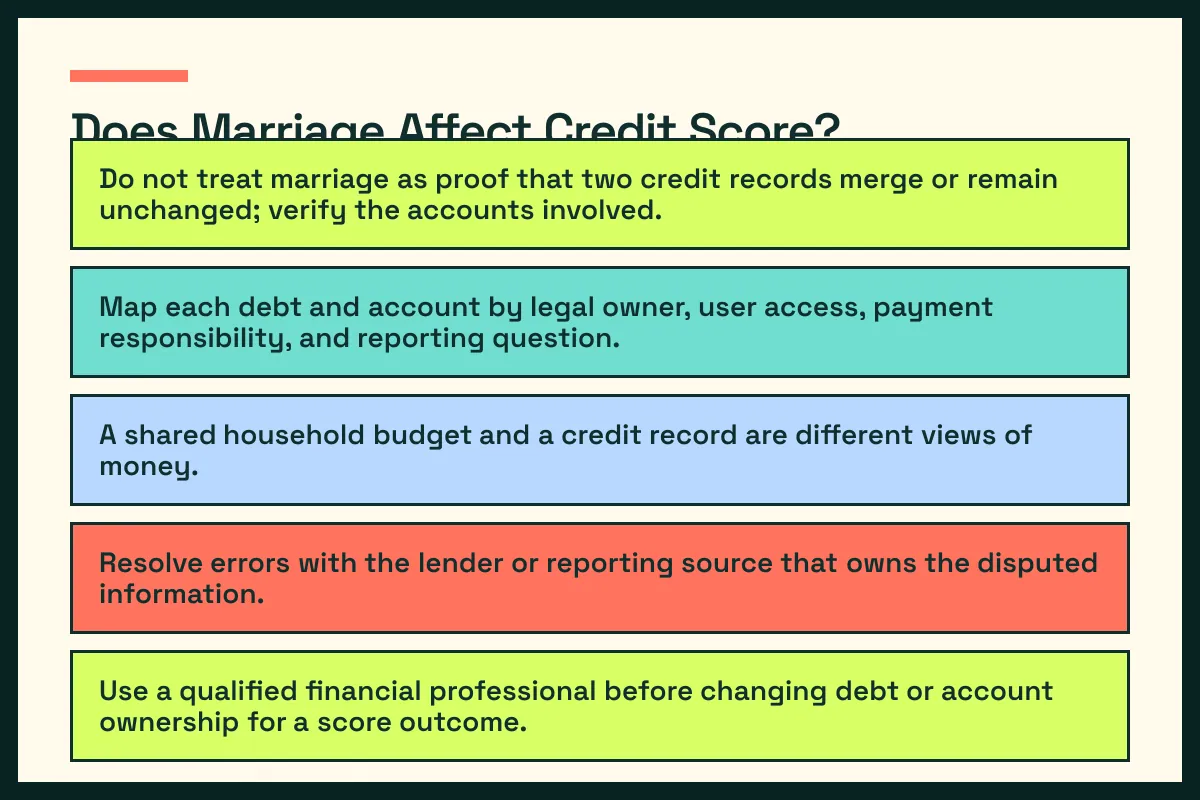
- Do not treat marriage as proof that two credit records merge or remain unchanged; verify the accounts involved.
- Map each debt and account by legal owner, user access, payment responsibility, and reporting question.
- A shared household budget and a credit record are different views of money.
- Resolve errors with the lender or reporting source that owns the disputed information.
- Use a qualified financial professional before changing debt or account ownership for a score outcome.
- 1List every credit account connected to either spouse.
- 2Mark the legal owner and any authorized-user access.
- 3Separate household payment responsibility from account ownership.
- 4Review each spouse's available credit records for discrepancies.
- 5Ask the lender or reporting source about unclear entries.
- 6Avoid opening, closing, or transferring debt from a score assumption.
- 7Record corrections and revisit the account map after changes.
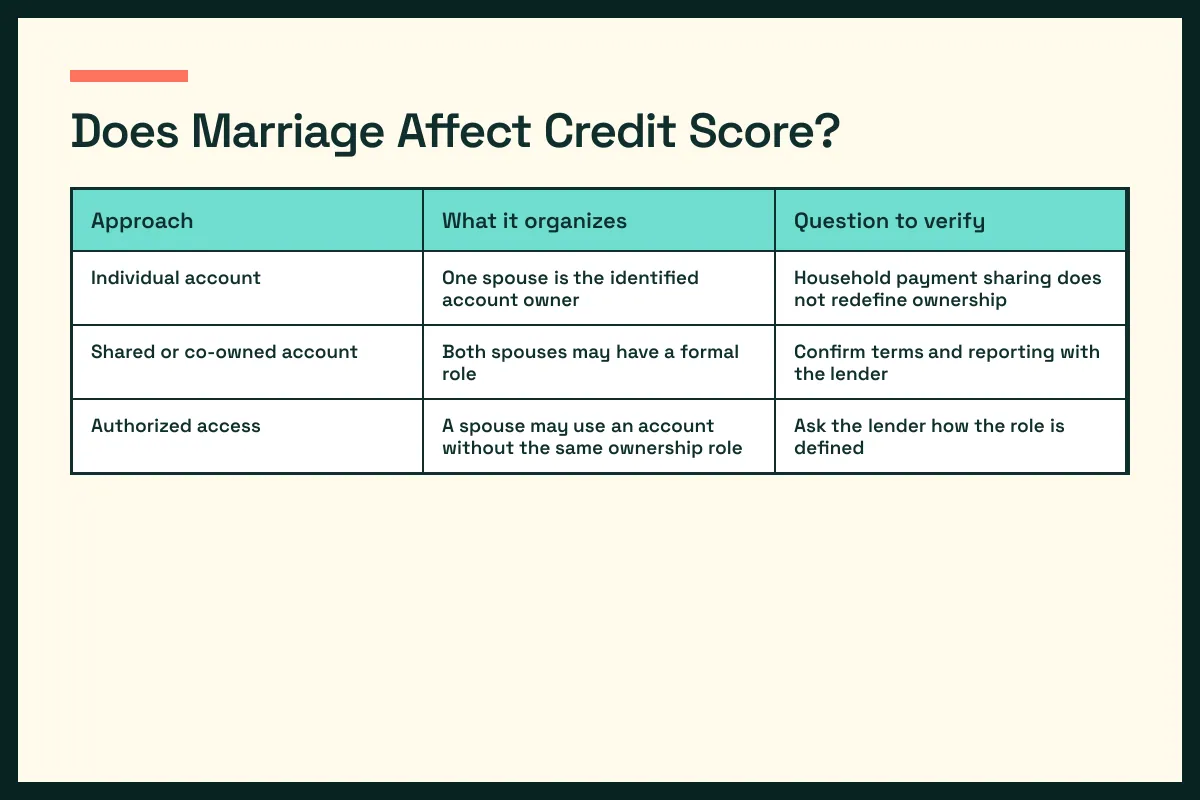
| Approach | What it organizes | Question to verify |
|---|---|---|
| Individual account | One spouse is the identified account owner | Household payment sharing does not redefine ownership |
| Shared or co-owned account | Both spouses may have a formal role | Confirm terms and reporting with the lender |
| Authorized access | A spouse may use an account without the same ownership role | Ask the lender how the role is defined |
does marriage affect credit score
does marriage impact credit score
does getting married affect credit score
will getting married affect credit score
marriage affect credit score
Does marriage affect a credit score? The useful answer starts below the marriage label, at the account level. This page’s structured data contains no credit rule or score formula, so it does not publish a universal prediction.
Instead, build an account map. Show who owns each obligation, who can use it, who pays it in the household plan, and which lender or reporting source can answer a discrepancy.
What should appear on a household credit map?
List accounts connected to either spouse. For each, record the legal owner, any co-owner, any authorized access, the household payment owner, and an unresolved reporting question.
Keep balances, account numbers, and report files in secure storage. The shared map needs roles and statuses, not sensitive values.
Do not add an account from assumption. Verify it through the spouse’s own records or the account provider.
Why separate account ownership from bill payment?
A couple can decide that one spouse pays a household bill without changing the legal account owner. The household budget records responsibility; the lender’s system records account roles.
Write both fields. This prevents “we both pay it” from becoming an unsupported claim about ownership or reporting.
If the roles are unclear, ask the lender. Do not infer them from who holds a card, receives a statement, or logs in most often.
How should spouses review their credit records?
Each spouse should access their own available records through the responsible source and look for accounts, roles, and entries they do not recognize or understand.
Compare the records with the account map. A difference becomes a specific question: an unknown account, an incorrect role, a payment entry, or a provider detail. Avoid reducing every difference to “marriage changed the score.”
Keep disputes private. Share the status with the spouse, but protect report contents and identity information.
What should you ask before opening a shared account?
Ask the lender how ownership, application, access, payment responsibility, and reporting work for the product. These are lender-specific questions.
Discuss why the household wants the account. A shared expense may not require shared debt, and a desire for visibility may be solved through a different household process. This guide does not recommend a product.
Do not apply for an account solely to influence a score without qualified advice and current lender information.
How should authorized access be handled?
Ask the lender what the access role means and what it permits. Do not assume that using a card, viewing an account, or receiving alerts makes a spouse an owner.
Record the exact role in the account map. If the household no longer wants that access, request the lender’s current change process.
Avoid promising a score result from adding or removing access. The project data contains no supported effect.
Can couples combine a budget without combining credit?
A budget is an agreement about household money. A credit account is a record owned and governed by a provider. The couple can coordinate payments and goals while keeping those concepts distinct.
Use the budget to show who funds obligations and how both spouses monitor shared risk. Use the account map to show legal roles and reporting questions.
If the couple wants to change ownership, debt, or access, contact the provider and seek qualified advice about individual consequences.
What can you do when a report appears wrong?
Identify the exact account and entry. Gather the account record and the reporting source’s current dispute instruction. Ask the organization responsible for the information to investigate.
Do not send a broad marriage explanation when the issue is a specific account role or entry. A precise dispute is easier to understand and document.
Save the request and outcome. Keep the map status open until the responsible source responds.
How should spouses talk about different credit histories?
Use facts that each spouse chooses to share. Focus on current obligations, open problems, and household decisions. Avoid turning a score into a character judgment.
Ask what support is wanted. One spouse may want help organizing payments, while the other may want privacy and a clear boundary around separate debt.
Agree on which information is necessary for shared decisions. Seek a qualified professional when debt, lending, or legal responsibility is unclear.
What account changes require extra caution?
Opening, closing, refinancing, transferring, consolidating, or changing ownership can have consequences that this general guide cannot predict. Do not act from a hoped-for score result.
Ask the provider to explain the product action. Bring the current records to a qualified financial professional if the household cannot evaluate the effect.
Keep “researching” distinct from “approved.” A conversation about a possible change should not be mistaken for consent to submit an application.
How do you keep the map current?
Give every disputed entry a small evidence trail. Record the account owner, the source showing the entry, the date it was reviewed, the organization contacted, and the current response. Avoid copying full report data into the shared map.
When a provider corrects an entry, verify the result through the relevant source rather than relying only on the request confirmation. If the outcome remains unclear, leave the task open and ask how the provider confirms completion.
Use the map to prepare professional questions. A lender can explain its account role and product terms. A reporting source can explain its dispute process. A qualified financial professional can help evaluate a proposed account or debt change. Keep each answer within that owner’s scope.
When a spouse chooses not to share a private report, agree on the household facts still needed for joint decisions. Ownership, required payments, disputed status, and the existence of an unresolved risk may be discussable without exposing the full file.
Document consent before one spouse contacts a provider about the other’s account. The guide cannot grant access, and a shared household goal does not replace the provider’s authorization rules.
Keep private records with their owner.
Update it when an account opens, closes, changes role, enters dispute, or receives a confirmed correction. Attach the provider’s outcome without copying sensitive data into the shared view.
Review the map alongside the household budget. The two tools answer different questions, but discrepancies between them can reveal an unassigned obligation or mistaken assumption.
The goal is not a shared score. It is a shared understanding of the accounts that affect household decisions.