
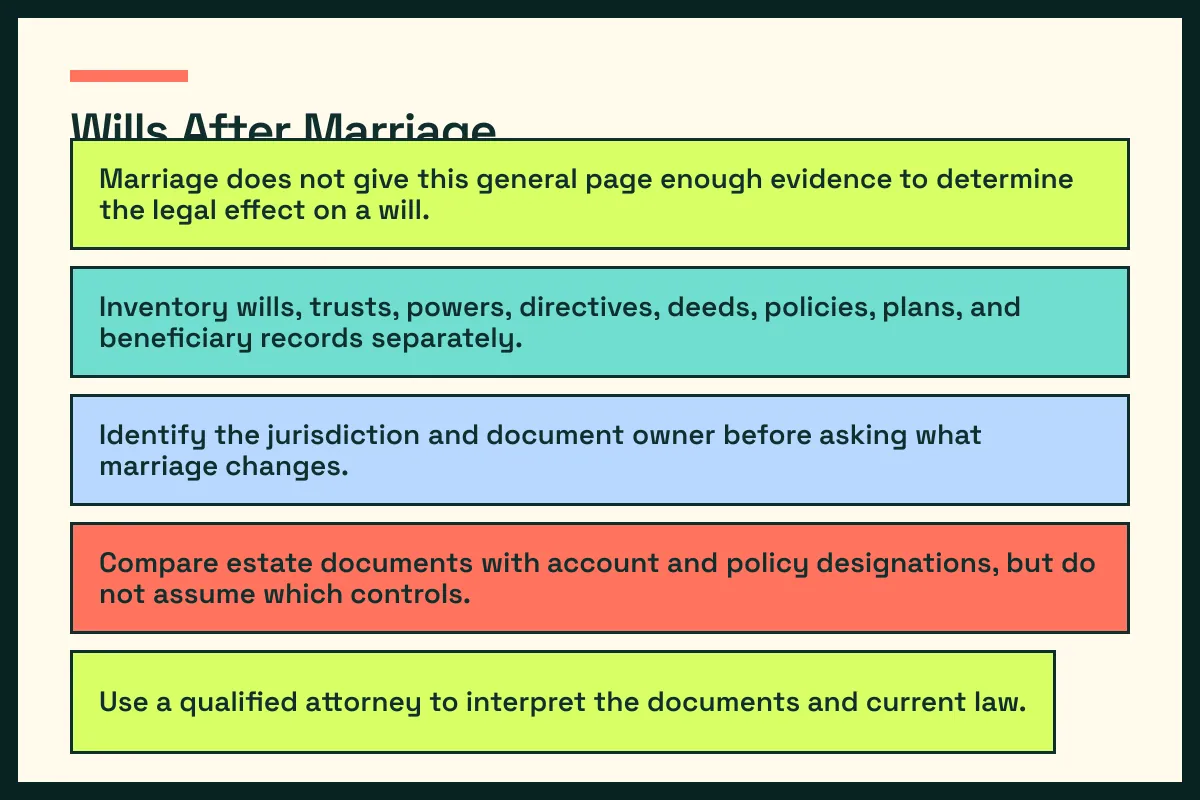
- Marriage does not give this general page enough evidence to determine the legal effect on a will.
- Inventory wills, trusts, powers, directives, deeds, policies, plans, and beneficiary records separately.
- Identify the jurisdiction and document owner before asking what marriage changes.
- Compare estate documents with account and policy designations, but do not assume which controls.
- Use a qualified attorney to interpret the documents and current law.
- 1Locate every will and related estate document.
- 2Record the document date, owner, and jurisdiction without exposing private contents.
- 3List trustees, agents, executors, and beneficiaries as items for attorney review.
- 4Inventory account, policy, and plan beneficiary records separately.
- 5Write every apparent conflict as a question, not a conclusion.
- 6Review the documents and questions with a qualified attorney.
- 7Save signed outcomes securely and schedule a future review.
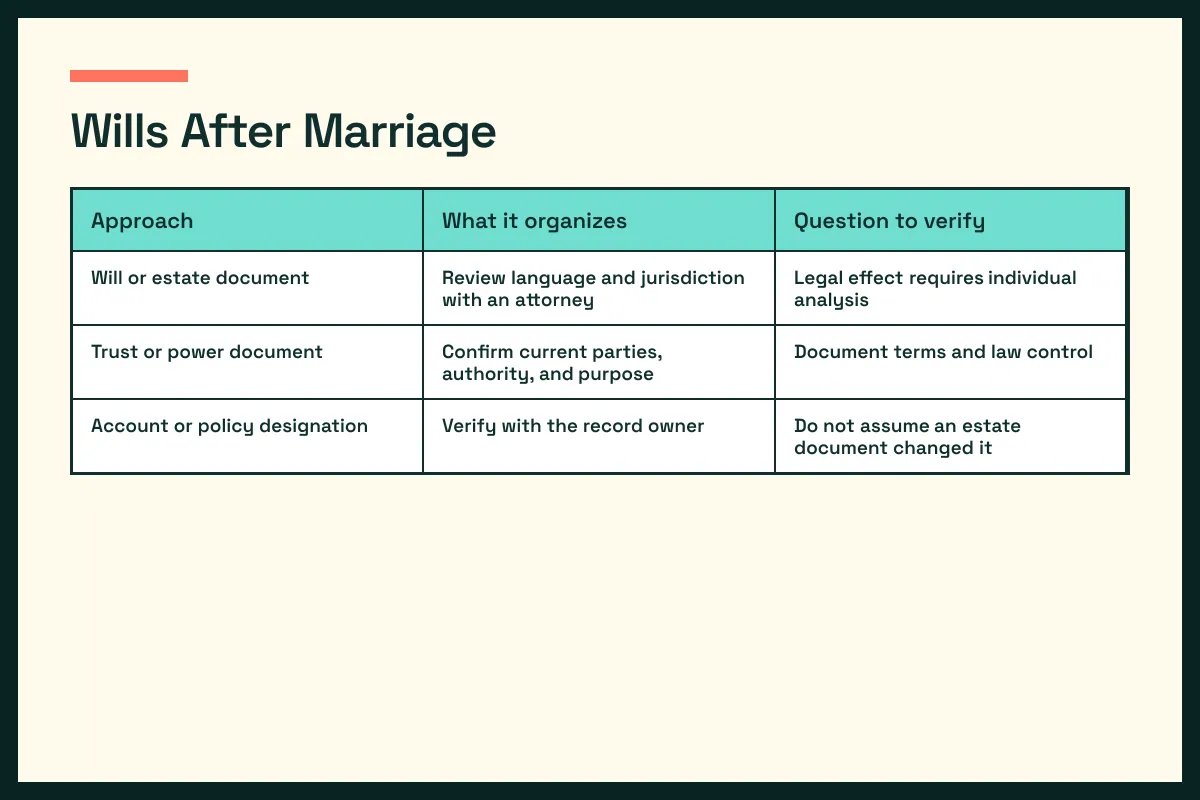
| Approach | What it organizes | Question to verify |
|---|---|---|
| Will or estate document | Review language and jurisdiction with an attorney | Legal effect requires individual analysis |
| Trust or power document | Confirm current parties, authority, and purpose | Document terms and law control |
| Account or policy designation | Verify with the record owner | Do not assume an estate document changed it |
wills after marriage
does marriage void a will
does marriage void a will in ontario
does marriage revoke a will
does marriage invalidate a will
Wills after marriage need a document review, not a universal yes or no. The protected questions ask whether marriage voids, revokes, or invalidates a will, but this project contains no jurisdiction-specific legal source that supports any of those outcomes.
Build an inventory and take it to a qualified attorney. The inventory helps the attorney see the documents, record owners, jurisdictions, and apparent conflicts without the couple trying to interpret legal effect alone.
Which estate documents should you locate?
Find each spouse’s will and any trust, power, directive, deed, policy, plan, or beneficiary record relevant to the estate conversation. Use the title shown on the document or provider record.
Record who owns the document, where it is stored, and which jurisdiction may be relevant. Do not paste private terms into a shared task board.
If a document cannot be found, mark it missing. Do not recreate its contents from memory.
Why does jurisdiction belong at the top of the review?
The effect of marriage on a will is a legal question. This general page has no jurisdictional rule, so it cannot tell a reader whether a document remains valid or changes.
Identify where the document was prepared and where the spouses now live or hold relevant property. Bring those facts to a qualified attorney, who can determine which questions matter.
The Ontario FAQ seed demonstrates the risk of a universal answer. A place name changes the legal research task. Use a professional qualified for that jurisdiction.
What people and roles should be reviewed?
List the people named as executors, trustees, agents, guardians, beneficiaries, or other roles using the document’s own terms. The list is for attorney review, not a conclusion about current authority.
Ask whether marriage affects any appointment, share, consent, or priority. Do not assume a spouse automatically replaces a named person.
If a named person is no longer suitable or available, record the concern. The attorney can explain which document action is needed.
How should beneficiary records be compared?
Inventory account, policy, and plan designations separately from the will. Verify the current entry with each record owner where appropriate.
Place apparent differences in a conflict list. Do not write that one record overrides another. The project data supports no such rule, and the answer may depend on document terms and law.
Bring the conflict list to the attorney and, where needed, to the plan or policy owner. Keep each response tied to the record it covers.
What should spouses discuss before meeting an attorney?
Discuss intended beneficiaries, decision makers, dependents, property concerns, personal representatives, health wishes, and access to essential information. These topics prepare the agenda; they do not create legal documents.
Each spouse should state individual wishes without assuming they must be identical. Mark disagreements or uncertainty openly so the attorney can explain available structures.
Avoid drafting final legal clauses from a checklist. Use the conversation to identify questions and evidence.
How can you prepare a useful attorney agenda?
Group questions by document. For the will, ask about marriage, jurisdiction, appointments, property, and execution. For a trust, ask about parties, powers, and relationship to the broader plan. For beneficiary records, ask which owner must make any change.
Attach the inventory and conflict list. Tell the attorney which documents are missing or unsigned rather than hiding gaps.
Ask for the scope of the review and which follow-up belongs to another professional. Tax, property, insurance, and plan questions may require different expertise.
What should happen to outdated or draft documents?
Do not destroy or overwrite a material document based on this general article. Show prior, current, and draft versions to the attorney and ask what should be retained.
Label working copies clearly and store signed originals securely. Keep access instructions where the appropriate people can find them without exposing private contents broadly.
A filename or handwritten edit does not prove legal validity. Use the attorney’s execution instructions.
What can you do when documents appear to conflict?
Write the conflict in neutral terms: “the will names one person; the policy record shows another.” Avoid deciding which controls.
Gather the relevant documents and owner confirmations. Ask the attorney to interpret the interaction and identify the correct change owner.
Resolve changes through the responsible document or provider process. Keep confirmation from each owner.
How should the final estate plan be stored?
Follow the attorney’s advice for originals and copies. Keep a private index that shows which documents exist, where they are held, and who should know how to access them.
Do not place full estate documents in an ordinary household task tool unless the couple has chosen a secure method appropriate for them.
Review access with the people who need a role, without disclosing more than necessary.
When should the plan be reviewed again?
Create a post-meeting action list by owner. The attorney’s list covers document drafting, execution, legal interpretation, and any jurisdiction research. An insurer or plan administrator handles its own designation record. The couple handles secure storage, access instructions, and the personal decisions that remain open.
Do not combine all advice into a single statement that “the estate plan is updated.” Mark each document or provider record separately. A signed will, an unsigned trust draft, and an unconfirmed policy designation have different statuses.
Ask the attorney what evidence should be retained after a change and how prior versions should be handled. Follow that advice instead of deleting files from a generic cleanup rule.
Finally, create a private index rather than a public summary. The index can name the document, owner, location, review status, and responsible professional without reproducing beneficiaries, property details, health wishes, or account values. Share access only with the people the couple and attorney identify.
Test the index as a recovery tool. A trusted person identified by the plan should be able to locate the professional and the intended document storage without searching email, guessing filenames, or opening unrelated financial records. Ask the attorney what access is appropriate.
If the test reveals an old draft beside a signed document, label the ambiguity and seek instruction. Do not solve it through deletion or assumption.
Use life and record changes as reminders to ask whether a review is needed. This page does not claim that any event automatically changes a legal document.
Return to the inventory, verify provider designations, and update the attorney agenda. A repeatable review process is more reliable than assuming an earlier plan still reflects current intentions.
The final legal answer belongs to current law, the signed documents, and qualified professional review.